How to Understand Gen Alpha Consumers: A Strategic Guide for 2026
The primary identity driver has shifted. While Gen Z mastered social fluency and the art of the "feed," Alpha lives in a state of algorithmic immersion
Jembe.Intelligence
July 11, 2026

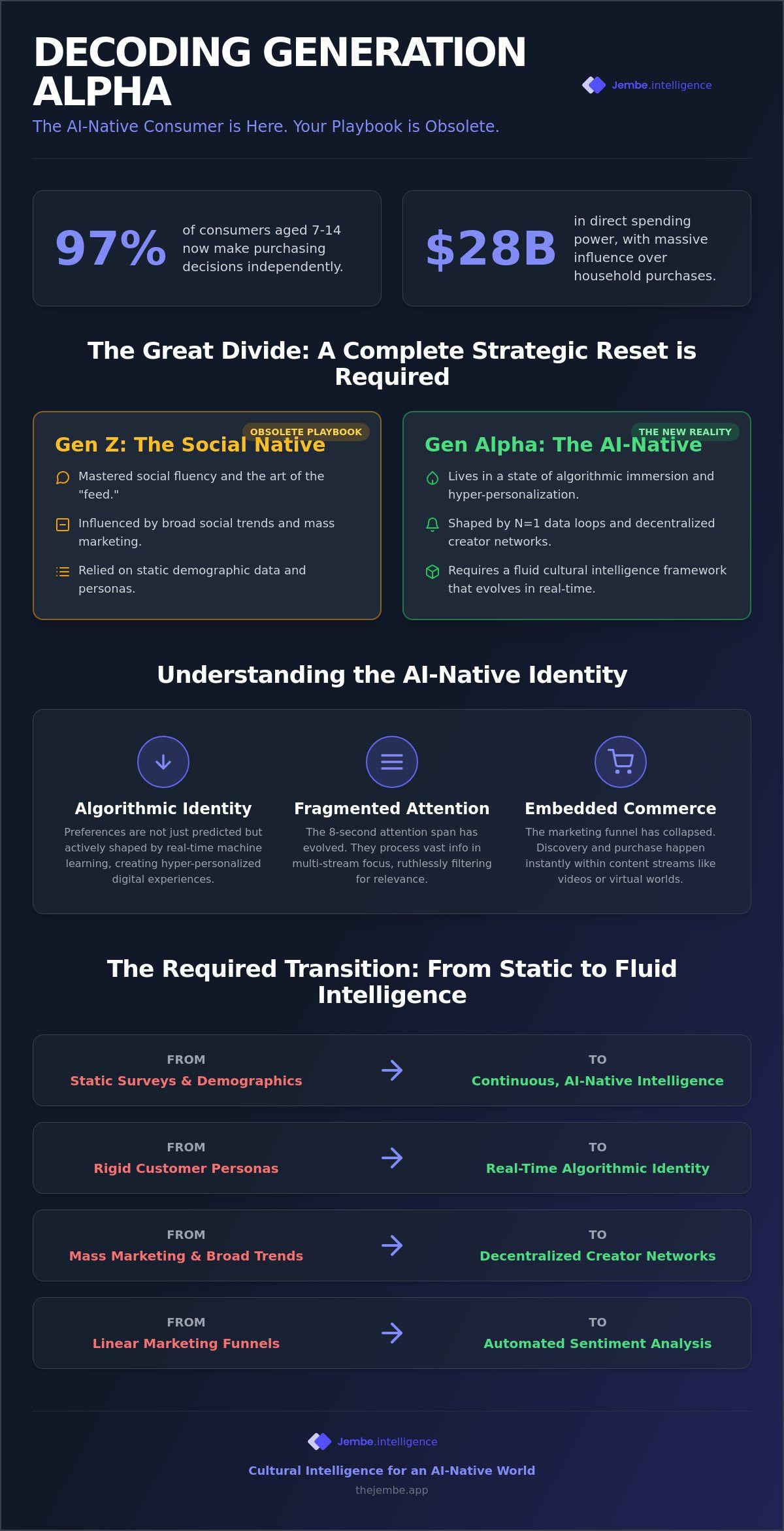
Ninety-seven percent of consumers aged seven to fourteen now make purchasing decisions independently. This isn't a future projection. It's a high-velocity reality. If your strategy relies on static demographic data, you're already falling behind. Learning how to understand gen alpha consumers is the only way to capture your share of the $28 billion spending power shift currently underway. You likely feel the urgency as the "Glass Generation" operates at a speed that traditional research can't match, leaving the distinction between Gen Alpha and younger Gen Z dangerously blurred. This shift demands a departure from slow-moving, traditional models that fail to capture the nuance of a cohort that has never known a world without generative AI.
Jembe.intelligence provides a sophisticated framework for decoding AI-native consumer identity through advanced sentiment analysis and real-time research methodologies. We'll explore how to transition from tracking what they buy to understanding the algorithmic fluency that defines who they are. By the end, you'll have a repeatable system for maintaining cultural relevance in an environment that never stops evolving. It's time to embrace a more agile, technologically-driven approach to understanding your environment and the people within it.
Key Takeaways
- Ditch the Gen Z playbook. Alpha is a distinct cohort that demands a complete strategic reset to remain culturally relevant.
- Master how to understand gen alpha consumers by replacing static surveys with continuous, AI-native intelligence streams.
- Decode the "Glass Generation" by analyzing algorithmic identity, where personalized feeds create hyper-segmented behaviors that traditional data can't track.
- Transition from rigid demographic tracking to a fluid cultural intelligence framework. This allows your brand to build custom personas that evolve in real-time.
- Capture the $28 billion spending power shift. Use automated sentiment analysis to stay ahead of the curve as formative behaviors solidify.
The Gen Alpha Disruption: Why Your Gen Z Playbook Is Obsolete
Stop looking for Gen Z 2.0. It doesn't exist. Many brands make the fatal mistake of assuming continuity between these cohorts, but 2026 represents a hard break in consumer behavior. Generation Alpha is the first group born entirely within the 21st century. They are reaching their peak formative years right now. This isn't a slow transition; it's a high-velocity pivot. If you want to know how to understand gen alpha consumers, you must first accept that your existing social media playbooks are fundamentally broken.
The primary identity driver has shifted. While Gen Z mastered social fluency and the art of the "feed," Alpha lives in a state of algorithmic immersion. Their preferences aren't shaped by broad social trends, but by hyper-personalized, N=1 data loops that evolve every second. This creates a fragmented landscape where traditional demographic data fails to predict the next move. By 2026, the velocity of this change marks a tipping point where their cultural influence far outweighs their current age.
Beyond Digital Native: The AI-Native Paradigm
Alpha doesn't view AI as a tool or a novelty. It's a fundamental layer of their reality. They are the first true AI-natives, using generative tools for everything from creative expression to brand discovery. For this cohort, an interface that doesn't learn and respond in real-time feels broken. They expect brands to be as agile and predictive as the algorithms they interact with daily. Static content is dead; interactive, AI-driven engagement is the new baseline for relevance.
The Household Proxy: Decoding Influenced Spend
Don't let the "child" label fool you. While their direct spending power is already significant at $28 billion, their true economic impact is the "Millennial Parent" filter. Alpha children exert massive influence over hundreds of billions in household decisions, from electronics to travel. Understanding how to understand gen alpha consumers requires mapping this proxy relationship. You aren't just selling to a kid; you're navigating a sophisticated household ecosystem where the child is often the primary discovery engine for new brands and technologies.
Decoding the Glass Generation: AI-Native Identity and Algorithmic Influence
Gen Alpha doesn't just use technology. They inhabit it. Often called the "Glass Generation," these individuals have interacted with screens since infancy, blurring the line between physical and digital reality. This constant connectivity creates a unique psychological profile. To master how to understand gen alpha consumers, you must look past the screen and into the engine driving their choices. Algorithmic Identity is a continuous feedback loop where real-time machine learning models mirror and refine consumer behavior into hyper-personalized digital experiences. This loop doesn't just predict what they want; it actively shapes who they are becoming.
Traditional personas are dead. Static demographic buckets can't capture "N=1" consumer segments that shift based on a single swipe. Recent consumer data on Gen Alpha highlights that their attention isn't just short; it's fragmented. The 8-second attention span has evolved into a highly selective, multi-stream focus. They process vast amounts of information simultaneously while ruthlessly filtering out anything that lacks immediate relevance or authenticity.
The Death of Mass Influence
Mass marketing is a relic. Alpha places zero trust in legacy brand authorities. Instead, they look to decentralized creators and peer networks. Gaming platforms like Roblox and Minecraft have become their primary "third spaces" for social interaction. It's where they build identity, establish status, and consume culture. Authority has shifted from institutions to individual creators, and participation is the only valid form of brand engagement.
Commerce Embedded into Content
The traditional marketing funnel has collapsed into a single point of impact. Discovery and purchase now happen in the same breath, often within a short-form video or a virtual world. This high-velocity transaction requires a new level of strategic agility. Leveraging automated sentiment analysis is the only way to capture these fleeting cultural pulses before they vanish. Brands that can't move at the speed of the algorithm will find themselves perpetually out of sync. You can explore the Jembe.intelligence platform to see how real-time intelligence bridges this gap.
Modern Methodologies: How to Research the First True AI-Native Cohort
Static surveys are dead. They feel like homework to a generation that expects every digital interface to be a dialogue. To master how to understand gen alpha consumers, you must pivot to interactive, high-velocity research models. This means abandoning project-based snapshots in favor of continuous intelligence. Always-on data streams allow you to track the subtle shifts in algorithmic identity as they happen. You cannot rely on data that is months old when their world evolves in seconds. Real-time feedback is the only way to maintain a pulse on a cohort that treats technology as an extension of their own consciousness.
Capturing lived experiences requires looking through their "glass." This involves leveraging real-time sentiment analysis to decode the emotional subtext behind a swipe, a comment, or a virtual interaction. You need to see the world as they do, without the distortion of adult-designed frameworks. True intelligence comes from observing behavior in its natural, digital habitat. It's about moving from "What did you do?" to "What are you feeling right now?" by analyzing the digital breadcrumbs they leave across decentralized platforms.
The Power of Managed Qualitative Research
Numbers alone are insufficient. You need nuance. Implementing managed qualitative research allows you to bridge the gap between hard data and human behavior. Digital diary studies are particularly effective here. They capture authentic moments in their natural environment, providing a raw look at their interactions without the artificiality of a focus group. This methodology ensures you capture the "why" behind the "what" at the speed of culture.
Ethical Research in the Alpha Era
Trust is the new currency. Navigating privacy in 2026 requires more than just legal compliance. It demands a transparent, value-driven exchange where consumers feel their data is respected and utilized to improve their experiences. Building this trust is essential for gaining access to the honest, unscripted insights that define this generation. Brands that prioritize data ethics will find a more engaged and vocal participant pool.
Ready to evolve your research strategy? Explore how to deploy continuous intelligence with Jembe.intelligence.
Engineering Radical Relevance: Implementing a Cultural Intelligence Framework
Stop chasing trends. Start predicting them. The final step in mastering how to understand gen alpha consumers is the total transition from demographic tracking to cultural intelligence. Static data is a liability; it creates a false sense of security while the market shifts beneath you. To remain relevant, you need a framework that moves at the speed of the algorithm. This involves building custom cultural personas that aren't just portraits, but living systems that evolve as new digital behaviors emerge.
Your brand must position itself as a sophisticated strategic partner within the Alpha household. This generation respects brands that offer utility, transparency, and high-tech fluency. Cultural intelligence is the only future-proof operating system for 2026 because it prioritizes the fluid subtext of human behavior over the rigid, lagging indicators of traditional data. By adopting this mindset, you move from reactive observation to proactive influence.
From Insights to Actionable Momentum
Data without direction is noise. Turning automated sentiment reports into high-impact marketing maneuvers requires a platform designed for speed. The Jembe Platform serves as your high-tech guide, translating complex behavioral shifts into clear strategic paths. We help you move beyond the "what" and into the "so what," ensuring your team has the momentum to act before a cultural window closes. It's about precision, not just volume.
Anticipating the Next Shift
Category dominance requires foresight. By leveraging quantitative syndicated research, you can benchmark your brand against the broader shifts in the Alpha landscape. This macro-view, combined with your custom qualitative insights, creates a powerful defensive and offensive strategy. You'll see the disruptions coming before they hit the mainstream. Don't just watch the evolution. Accelerate it.
Ready to lead the shift? Subscribe to The Jembe Platform and start engineering radical relevance today.
Own the Algorithmic Horizon
The shift from Gen Z to Gen Alpha isn't a linear progression. It's a hard break. By 2026, dominance belongs to those who move beyond static tracking to embrace living cultural intelligence. You've seen the evidence. The old playbook is obsolete. AI-native identity requires decoding how consumers think within algorithmic feedback loops rather than just tracking what they buy. Mastering how to understand gen alpha consumers is now the primary differentiator between market leaders and those left behind by the sheer velocity of culture.
The Jembe is your visionary strategic partner. We deliver the high-tech tools required to navigate the "Glass Generation" with absolute precision. Through automated sentiment analysis and custom cultural persona development, we bridge the gap between raw data and actionable momentum. Don't let your strategy lag. Accelerate your strategic evolution with The Jembe Platform. The evolution is happening. It's time to lead it.
Frequently Asked Questions
What is the primary difference between Gen Z and Gen Alpha consumers?
The core distinction lies in the shift from digital fluency to algorithmic immersion. While Gen Z adapted to social media as digital natives, Gen Alpha is the first true AI-native cohort, experiencing life through an integrated layer of machine learning and "glass" interfaces from birth. Their identity is predictive, hyper-personalized, and shaped by real-time feedback loops that define their perception of reality.
How much direct spending power does Gen Alpha have in 2026?
Gen Alpha accounts for $28 billion in direct spending power by 2026, but their economic footprint is much larger. They act as the primary discovery engine for Millennial parents, influencing hundreds of billions in household decisions across categories like electronics, travel, and food. This "household proxy" effect makes them the most influential consumer cohort in modern history despite their young age.
What are the best research methods for understanding Gen Alpha kids?
Effective research requires a move toward continuous intelligence and managed qualitative studies. Static surveys fail because they lack the interactivity this generation expects. To master how to understand gen alpha consumers, brands must use digital diary studies and real-time sentiment analysis to capture authentic, lived experiences within their natural digital habitats without the interference of adult-designed frameworks.
How does AI influence Gen Alpha's brand discovery and shopping habits?
AI is the fundamental discovery layer for this generation, replacing traditional search with algorithmic curation. They utilize generative AI tools for creative expression and product discovery, expecting every interface to be predictive and responsive. For Gen Alpha, a brand that doesn't learn and adapt to their specific "N=1" segment in real-time feels fundamentally broken and culturally irrelevant.
Why is cultural intelligence more important than demographic data for Gen Alpha?
Demographic data is a lagging indicator that cannot keep pace with the high-velocity shifts of the "Glass Generation." Cultural intelligence provides a future-proof operating system by decoding the fluid emotional subtext of human behavior. By focusing on how to understand gen alpha consumers through cultural lenses, brands can build custom personas that evolve at the speed of the algorithm rather than relying on static, outdated buckets.
Want this kind of intelligence wired into your team's workflow? Get started with Jembe.Intelligence →