Integrating Consumer Insights Into business Strategy: The 2026 Cultural Fluency Framework
Speed is your greatest competitive edge. Integrating consumer insights into business strategy requires shortening the distance between discovery and execution. A living strategy doesn't sit in a binder; it evolves.
Jembe.Intelligence
May 27, 2026

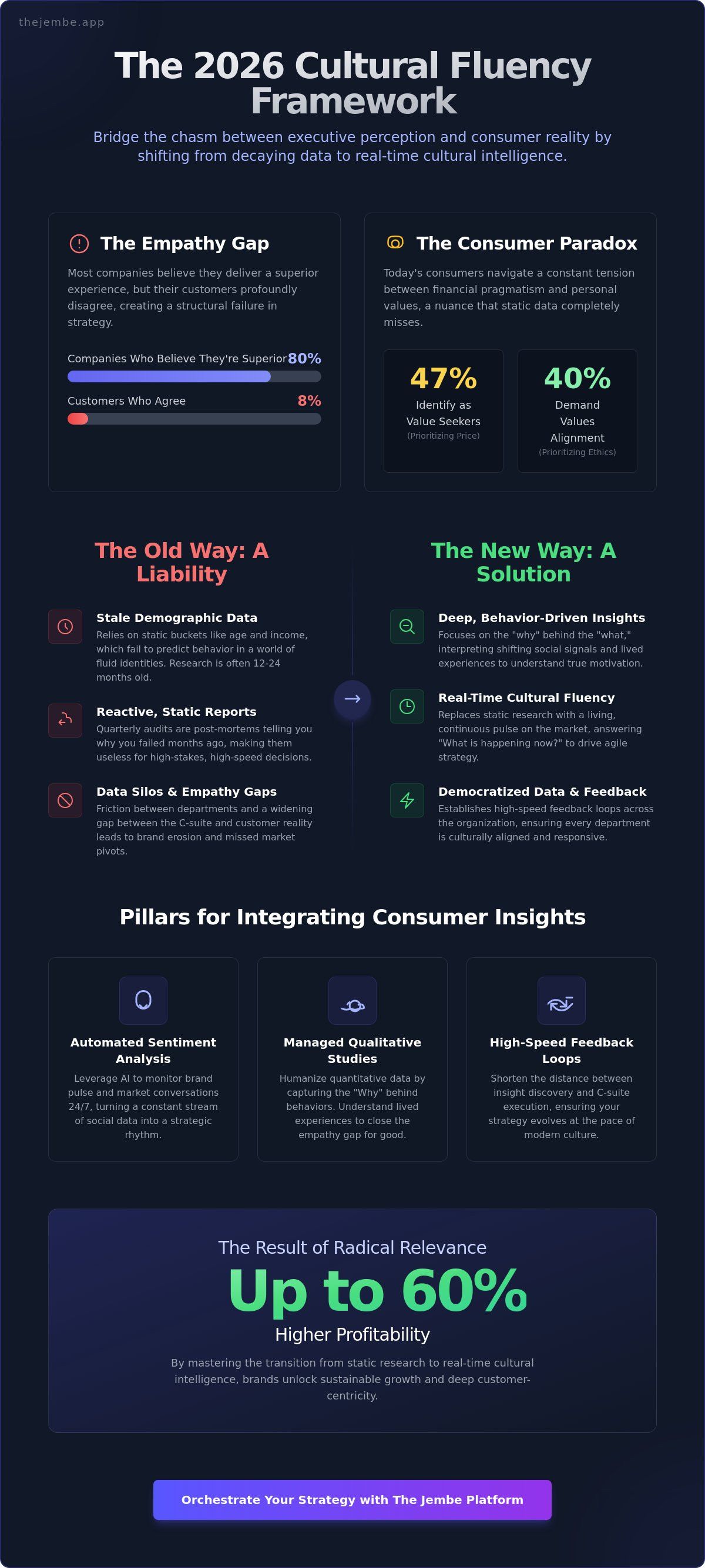
47% of global consumers now identify as value seekers who prioritize price over brand name, yet 40% still demand that companies align with their personal values. This paradox, combined with a complex web of new state privacy laws taking effect in January 2026, means the traditional methods of integrating consumer insights into business strategy have become a liability. You feel the friction of data silos. You see the empathy gap widening as static demographics fail to predict shifting identities. It's a race against obsolescence. The old map no longer works.
You recognize that staying relevant requires more than just data; it requires a living pulse on human behavior. This article introduces the 2026 Cultural Fluency Framework, a streamlined methodology designed to help you master the transition from stagnant research to real-time cultural intelligence. You'll learn how to drive radical brand relevance and unlock up to 60% higher profitability through deep customer-centricity. We're moving beyond the "what" of consumer data and into the "why" of human momentum. We're providing a clear roadmap for faster, smarter strategic execution.
Key Takeaways
- Bridge the chasm between executive perception and consumer reality by moving beyond decaying demographic data toward fluid, behavior-driven cultural intelligence.
- Accelerate your decision-making by integrating consumer insights into business strategy through a living framework that replaces static research with real-time market fluency.
- Democratize data access across your organization to ensure every department remains culturally aligned and capable of responding to rapid social shifts.
- Establish high-speed feedback loops between the insights team and the C-suite to drive radical brand relevance and unlock sustainable profitability.
- Leverage cutting-edge tools like automated sentiment analysis and managed qualitative studies to orchestrate a strategy that evolves at the pace of the modern world.
Beyond the Empathy Gap: Why Demographic Data Fails Modern Strategy
The Empathy Gap isn't just a buzzword; it's a structural failure. Most executives believe they understand their audience. They don't. Research from quirks.com suggests that 80% of companies believe they deliver superior experiences, yet only 8% of customers agree. This chasm exists because traditional market research relies on stale data. It treats human beings as static demographic buckets. But in 2026, identity is fluid. It's multicultural. It's driven by behavior rather than birth year. Relying on age or income to predict a purchase is a legacy tactic that leads to brand erosion and missed market pivots. The market moves. You wait. You lose.
Integrating consumer insights into business strategy requires a move toward deep, human-centric data. A foundational part of understanding consumer insights involves recognizing that a customer's motivation is often hidden beneath layers of social signaling and contradictory behaviors. In 2026, consumers are value seekers who still demand brand alignment with their personal ethics. You can't capture that tension in a spreadsheet. Cultural Intelligence is the ability to interpret and act on these shifting social signals in real-time.
The Failure of Static Market Audits
Quarterly reports are post-mortems. They tell you why you failed three months ago. In a world where social commerce and AI-driven journeys move at light speed, you can't wait for a PDF to tell you what happened. Static audits feel safe because they're predictable. They're also useless for high-stakes decision-making. The focus must shift from "What happened?" to "What is happening right now?". Integrating consumer insights into business strategy isn't a one-time event; it's a continuous, living process of adaptation. Real-time fluency is the only way to close the empathy gap and ensure your strategy remains radically relevant.
The Pulse of the Market: Moving from Static Research to Real-Time Fluency
Knowledge is a snapshot. Fluency is a conversation. Most brands settle for "knowing" their audience through secondary research that is often 12 to 24 months old. In a 2026 landscape where 22% of shoppers already use AI search tools for product research, that lag is fatal. Real-world relevance requires a shift toward real-time cultural intelligence. Stop observing from the sidelines. Start participating in the cultural current.
Integrating consumer insights into business strategy means moving beyond the "what" of quantitative charts to the "how" of human behavior. By leveraging an advanced cultural intelligence platform, leaders can harness automated sentiment analysis to monitor the brand pulse 24/7. This constant stream of data allows for actionable strategies for consumer insights that adapt as quickly as evolving universal opt-out mandates. You don't just need data points; you need the rhythm of the market.
Decoding Lived Experiences
Numbers tell you a purchase happened. They don't tell you the friction that almost stopped it. Managed Qualitative Research Studies humanize the data, capturing the "Why" behind the "What." It's about understanding the daily joys and frustrations of diverse audiences. When you prioritize lived experiences, you close the empathy gap. You move from generic targeting to radical relevance. Explore how The Jembe Platform transforms raw human stories into high-velocity strategic assets.
The Strategic Advantage of Real-Time Reporting
Speed is your greatest competitive edge. Integrating consumer insights into business strategy requires shortening the distance between discovery and execution. A living strategy doesn't sit in a binder; it evolves. It responds to the 17% of online sales expected to happen on social platforms by the end of 2026. It pivots when value seekers shift their priorities. Real-time reporting ensures your team isn't just reacting to the past but actively commanding the future.
5 Pillars for Integrating Consumer Insights into Your Business Strategy
Strategy is not a quarterly event. It is a living adaptation. To survive 2026, you must build an architectural pipeline that feeds human behavior directly into your decision engine. Most organizations fail because they treat insights as a destination rather than a fuel source. Integrating consumer insights into business strategy requires a fundamental shift from passive reporting to active execution. It demands a system that is as agile as the culture it tracks.
To master this transition, focus on these five core pillars:
- Establish a continuous feedback loop: Connect your insights team directly to the C-suite to ensure strategy reflects real-time reality.
- Democratize data access: Break down silos; every department must be culturally aligned to act with precision.
- Deploy Custom Cultural Persona Development: Replace generic, decaying demographic buckets with data-driven personas that reflect fluid identities.
- Measure Relevance ROI: Track sentiment shifts against market share to quantify the impact of your cultural fluency.
- Shorten the "Insight-to-Action" window: Eliminate the lag between discovery and strategic pivot.
Step 1: Audit Your Current Insight Velocity
Identify where your data gets stuck. If your insights take weeks to reach the strategy table, they're already obsolete. Assess the "freshness" of your current inputs. In a world where 17% of online sales will happen on social platforms by year-end, your data must move at the speed of a scroll. Look for the bottlenecks in your internal communication flow and eliminate them immediately.
Step 2: Implement Automated Sentiment Analysis
Filter the noise. Use Automated Sentiment Analysis Reports to identify high-impact cultural signals before they become mainstream trends. This isn't just about tracking mentions; it's about identifying shifts in category sentiment in real-time. Set up automated alerts for specific cultural triggers. This allows your team to pivot before the competition even notices the change. Speed is your only sustainable advantage.
Ready to transform your data into a high-velocity strategic asset? Subscribe to The Jembe Platform and start leading the market instead of following it.
Scaling Radical Relevance: How The Jembe Orchestrates Strategic Evolution
Relevance is a moving target. Scaling it requires an ecosystem, not just a tool. The Jembe Platform serves as a high-tech guide for navigating the complex social landscapes of 2026. It's a living system designed for leaders who recognize that integrating consumer insights into business strategy is a continuous pursuit of momentum. We don't just provide data; we provide a clear path through the noise. This is where strategic evolution begins. It's time to stop observing the market and start commanding it.
Our Managed Qualitative Research Studies deliver end-to-end human-centered data that fills the gaps left by traditional metrics. When you need category-wide intelligence without the custom-build timeline, our quantitative syndicated research provides immediate perspective. We also offer Custom Cultural Persona Development to replace those decaying demographic buckets with personas that reflect the fluid, multicultural reality of modern identity. Every component is engineered to drive radical relevance through technological sophistication and human depth.
From Data Points to Actionable Momentum
Analysis without action is overhead. Our generated reports translate complex cultural shifts into specific strategic directives. You won't just see a trend; you'll understand how to lead it. By using custom personas to refine multicultural marketing spend, you ensure every dollar resonates with the lived experiences of your audience. This level of precision is how integrating consumer insights into business strategy drives higher profitability. It's about turning signals into speed and data into a competitive advantage.
Join the Visionaries
The pace of the modern world doesn't wait for quarterly audits. Brands that lead in 2026 are those that speak the language of their customers in real-time. You have the choice to follow the old, static map or become a cultural innovator. The Jembe provides the intelligence, the framework, and the speed to ensure your brand stays ahead of the curve. Accelerate your strategic evolution with The Jembe platform today.
Command the Momentum: Your Roadmap to Cultural Fluency
The era of relying on quarterly post-mortems is over. To thrive in a landscape defined by fluid identities and shifting privacy regulations, your decision-making must move at the speed of culture itself. We've explored how the 2026 framework replaces decaying demographics with living intelligence. You now have the blueprint for integrating consumer insights into business strategy to drive radical brand relevance and unlock sustainable growth. The chasm between executive perception and consumer reality is closing. It's time to step across it.
Precision is no longer optional. By leveraging automated sentiment analysis for a real-time brand pulse and custom cultural persona development, you ensure your strategy stays ahead of every market pivot. Our managed research services provide the human depth needed to navigate this complex social terrain with absolute confidence. Don't let your brand become a relic of yesterday's stagnant data. The future belongs to the fluent, the agile, and the visionary. Your strategic evolution starts with a single, decisive step toward real-time intelligence. Request a Demo of The Jembe and Master Cultural Intelligence. Start commanding the future today.
Frequently Asked Questions
How does consumer insight differ from market research in 2026?
Market research in 2026 often remains a post mortem of historical data. Consumer insight is the living interpretation of human behavior that drives future action. It moves beyond what happened to reveal the cultural friction and joy behind every transaction. This real-time fluency allows for a more agile response to the 17% of online sales now happening on social platforms. It's the difference between looking in a rearview mirror and using a high tech radar.
Can automated sentiment analysis replace traditional qualitative research?
Automation doesn't replace human depth; it amplifies it. Automated sentiment analysis identifies high impact cultural signals at scale, while managed qualitative research decodes the nuanced lived experiences behind those signals. You need both to bridge the empathy gap. One provides the velocity. The other provides the human centered clarity required for radical relevance. They're two sides of the same strategic coin.
What is the first step to becoming a consumer-centric organization?
The first step is auditing your insight velocity to identify where data gets trapped in departmental silos. You must assess the freshness of the inputs currently driving your executive decisions. If your data doesn't move as fast as a viral trend, your strategy is already obsolete. Building a continuous feedback loop between your insights team and the C-suite is the only way to ensure integrating consumer insights into business strategy leads to actual market momentum.
How do you measure the ROI of integrating consumer insights into strategy?
Measure ROI by tracking Relevance ROI, which correlates real-time sentiment shifts with fluctuations in market share. Organizations that successfully prioritize customer centricity report 60% higher profitability compared to those relying on legacy methods. You aren't just measuring sales. You're measuring your brand's ability to maintain a living connection with its audience amidst shifting social landscapes and complex new privacy regulations.
Why is cultural intelligence critical for multicultural marketing?
Cultural intelligence is vital because modern identity in 2026 is fluid and behavior-driven rather than defined by static demographic buckets. Multicultural marketing fails when it relies on stereotypes or outdated census data. By integrating consumer insights into business strategy through cultural intelligence, you gain the ability to interpret shifting social signals. This ensures your brand remains radically relevant to diverse audiences who demand both competitive value and ethical alignment.
Want this kind of intelligence wired into your team's workflow? Get started with Jembe.Intelligence →