Qualitative vs. Quantitative Research: Orchestrating the Mix for Strategic Fluency
It's no longer about choosing a side in the qualitative vs quantitative research debate. It's about orchestrating a symphony of intelligence. You need the architecture of scale and the anatomy of meaning.
Jembe.Intelligence
August 07, 2026

The era of choosing between numbers and narratives is over. In a market where 80% of companies report revenue uplifts from real-time analytics, relying on static, siloed data is a recipe for irrelevance. You've likely felt the frustration of staring at a massive spreadsheet that tells you exactly what is happening but leaves the why a total mystery. It's a common friction point when debating qualitative vs quantitative research. Data without human context is just noise, and in a high-velocity environment, you can't afford to be slow or disconnected.
We're here to bridge that gap. By mastering these critical distinctions, you'll learn to build a research strategy that captures both massive scale and deep human soul. This isn't about picking a side. It's about strategic fluency. We'll break down how to fuse these methodologies into a high-tech, agile system that uncovers the hidden layers of consumer behavior in real-time. Prepare to move beyond conventional thinking and embrace a more sophisticated, technologically-driven approach to understanding your world.
Key Takeaways
- Define the distinct roles of numerical scale and human meaning to build a more sophisticated, multi-layered understanding of your market landscape.
- Apply the "Innovation vs. Optimization" framework to master the strategic timing of qualitative vs quantitative research throughout your entire product lifecycle.
- Discover how to orchestrate disparate data streams into a single, high-velocity research operating system that captures both massive scale and human soul.
- Leverage automated sentiment analysis to decode cultural shifts in real-time, ensuring your strategy remains as dynamic as the social landscapes it navigates.
- Audit your current data blind spots and define a cultural North Star to maintain strategic fluency and momentum in a shifting global market.
Decoding the DNA: Defining Qualitative and Quantitative Research
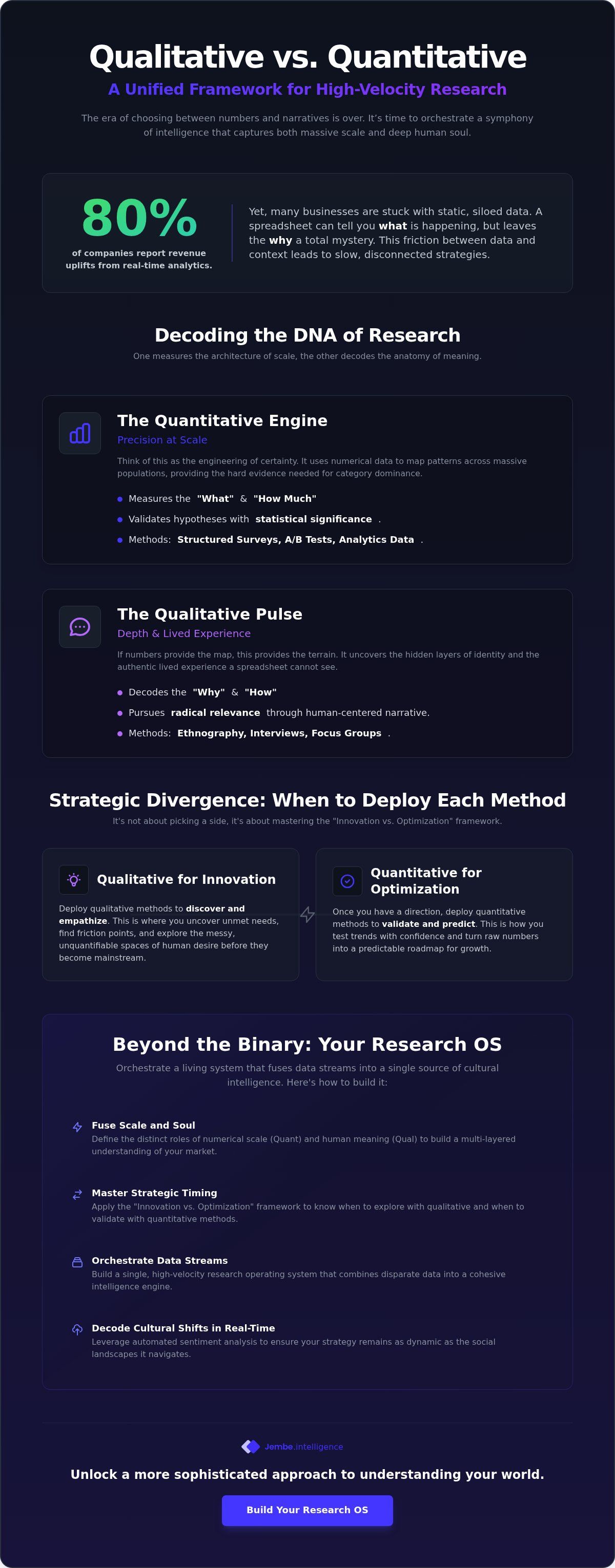
Static data is dead weight. To thrive in 2026, you need a living, breathing pulse of the consumer. It's no longer about choosing a side in the qualitative vs quantitative research debate. It's about orchestrating a symphony of intelligence. You need the architecture of scale and the anatomy of meaning. One measures the "what" and "how much," while the other decodes the "why." Together, they create strategic fluency. This shift from mechanical data collection to a living system is what separates market leaders from the noise.
The Quantitative Engine: Precision at Scale
Think of quantitative research as the engineering of certainty. It uses numerical data to map patterns across massive populations. By leveraging quantitative syndicated research, brands identify broad trends and validate hypotheses with statistical significance. This process relies on structured surveys and high-velocity data points. It provides the hard evidence needed for category dominance. Understanding the relationship between Quantitative and qualitative methods is essential for any strategist looking to validate their vision at scale.
The Qualitative Pulse: Depth and Lived Experience
If numbers provide the map, qualitative research provides the terrain. It's the anatomy of meaning. This methodology uses non-numerical data to explore the "how" and "why" behind human interaction. Through ethnography and managed studies, you capture the authentic lived experience of diverse audiences. Qualitative research is the pursuit of radical relevance through human-centered narrative. It uncovers the hidden layers of identity that a spreadsheet simply cannot see. It's about depth, not just volume.
The market moves fast. Traditional, slow-moving thinking fails because it treats data as a snapshot in time. You don't just need data; you need a pulse. By 2026, research must be an adaptive system that uncovers human interaction in real-time. This isn't just about collecting words or numbers. It's about building a high-tech guide for navigating complex social landscapes.
Strategic Divergence: When to Deploy Each Methodology
Strategy isn't about having all the answers. It's about knowing which questions to ask at the right moment. The binary debate of qualitative vs quantitative research often misses the critical point of velocity. In 2026, you don't just pick a method; you deploy a framework. We call this the Innovation vs. Optimization model. If you're building something new, you need discovery. If you're refining what works, you need validation. Understanding the inductive and deductive logic found in scholarly research methodologies allows you to pivot between these modes with surgical precision.
Qualitative for Discovery and Empathy
Innovation thrives in the messy, unquantifiable spaces of human desire. Use qualitative methods to uncover unmet needs before they hit the mainstream. This is where you build consumer empathy. It's about finding the friction points that don't show up on a bar chart yet. By commissioning Managed Qualitative Research Studies, you can dive deep into the lived experiences of your core audience. This depth is essential because traditional demographics are failing to capture the fluidity of modern consumer identity. You're looking for the soul of the movement, not just the size of the crowd.
Quantitative for Validation and Predictability
Once you've found the "why," you must prove the "how much." Quantitative research is your engine for optimization. It's how you test price elasticity and category trends with absolute confidence. It turns raw numbers into a predictable roadmap for growth. You can't scale a business on a hunch. You need the breadth of the market to validate the depth of the individual. This is where you measure the architecture of your success. If you're ready to bridge these two worlds, exploring custom cultural persona development can help you align your data with real human behavior.
Beyond the Binary: Orchestrating the Mix for Cultural Intelligence
Stop treating qualitative vs quantitative research as a binary choice. It's a false dilemma. In 2026, the most resilient brands don't just "combine" methods; they orchestrate them. This is mixed-methods research as a high-velocity operating system. Imagine a feedback loop where deep qualitative insights prime your quantitative surveys, and real-time numerical shifts trigger immediate ethnographic deep dives. It's a living system of intelligence that adapts as quickly as the people it studies.
The Cultural Intelligence Advantage
Success starts with understanding what is cultural intelligence in the context of research design. It's the lens that turns raw data into brand momentum. You aren't just looking for surface-level patterns. You're seeking deep-tissue insights that explain the shifting social landscapes your brand inhabits. This intelligence allows you to move with the market rather than reacting to it after the fact. It transforms data from a static report into a strategic asset.
Real-Time Synthesis in 2026
Speed is the ultimate differentiator. Traditional synthesis takes weeks; modern strategy demands seconds. By utilizing automated sentiment analysis, you bridge the gap between qualitative depth and quantitative speed. AI and machine learning now process thousands of human narratives to find the "soul" at scale. Our automated reporting transforms raw sentiment into actionable strategy, giving you the precision of a scalpel with the reach of a megaphone. You get the "why" and the "how much" in a single, streamlined flow.
Ready to outpace the competition with a more agile approach? Get started with the Jembe Platform Subscription to begin orchestrating your intelligence today.
Implementation at Velocity: Building Your Research Operating System
Speed is your primary asset. Static research plans are obsolete before the ink dries. To lead in 2026, you must build an engine that moves as fast as the market. Mastering the balance of qualitative vs quantitative research isn't a one-time event; it's a continuous state of evolution. You've already decoded the definitions and the strategy; now you must build the engine. Follow this four-step blueprint to operationalize your intelligence.
- Step 1: Audit your blind spots. Identify where the "why" is missing from your "what." If you have massive datasets but can't explain sudden shifts in behavior, you have a qualitative gap.
- Step 2: Define your cultural North Star. Stop tracking static demographics. Start tracking identity shifts. What core values are driving your audience right now?
- Step 3: Select your technology. Integrate a cultural intelligence platform that supports continuous evolution. You need a system that breathes.
- Step 4: Execute and pivot. Use high-velocity feedback loops to turn raw data into immediate action.
The Managed Research Model
Multicultural landscapes are complex. They require more than just software; they require expertise. Managed Qualitative Research Studies are essential for navigating these nuances without losing momentum. The shift from one-off projects to continuous consumer intelligence is what defines the visionary brands of this decade. You don't just need a report. You need a constant stream of human context that informs your numerical data in real-time.
Scaling with The Jembe
Growth requires a living system. The Jembe Platform Subscription enables real-time access to deep cultural data, allowing you to scale your insights without sacrificing soul. This is how you position your brand as a visionary leader. By fusing qualitative vs quantitative research into a single, high-tech workflow, you ensure radical relevance in every market you enter. Don't just watch the market change. Drive the change. Build a research operating system that captures both the architecture of scale and the anatomy of meaning.
Master the Future of Strategic Fluency
The market moves too fast for static snapshots. You've seen how the architecture of scale must meet the anatomy of meaning to create true strategic fluency. By moving beyond the binary choice of qualitative vs quantitative research, you position your brand to capture both the "what" and the "why" in a single, high-velocity stream. This isn't just about data collection. It's about building a living system that anticipates cultural shifts before they happen.
To thrive in 2026, you need a partner that understands the hidden layers of human interaction. We provide the tools to bridge the gap between deep-tissue insights and massive scale. Through end-to-end managed qualitative research studies and real-time automated sentiment analysis, we offer the precision you need to lead. Leverage custom cultural persona development to achieve radical relevance and ensure your strategy remains as dynamic as the world around it.
Accelerate your strategic evolution with The Jembe Platform Subscription. The future belongs to those who see the human soul within the numbers. Embrace the momentum. Your journey toward total strategic fluency starts today.
Frequently Asked Questions
What is the primary difference between qualitative and quantitative research?
The primary difference lies in the objective: quantitative research measures the architecture of scale through numerical data, while qualitative research decodes the anatomy of meaning through human narrative. Quantitative methods identify broad patterns and statistical trends. Qualitative methods uncover the hidden layers of lived experience. In the high-velocity debate of qualitative vs quantitative research, the former provides the map and the latter provides the terrain. Both are essential for a living, breathing system of intelligence.
Can qualitative research be used to validate a hypothesis?
Qualitative research is primarily an engine for discovery and empathy, though it can provide directional validation for nuanced cultural shifts. While quantitative methods are the gold standard for statistical proof, qualitative insights help you understand if your hypothesis aligns with authentic human behavior. It prevents you from validating a premise that's mathematically sound but culturally irrelevant. Use it to refine your vision before committing to massive scale and high-velocity execution.
How much quantitative data is needed for statistical significance in 2026?
The amount of data required depends entirely on your population size and the desired confidence interval, typically 95%. In 2026, the convergence of technology and data analytics means we can process larger datasets with higher velocity than ever before. While a sample of 400 to 1,000 is often sufficient for broad consumer markets, real-time analytics platforms allow for continuous, rolling validation. The goal is precision that drives measurable business outcomes rather than just hitting a static number.
Is qualitative research more expensive than quantitative research?
Cost is relative to the depth and scale of the intelligence you require. Managed qualitative research studies often involve high-touch human interaction and deep analysis, which can carry a higher per-participant cost. However, massive quantitative syndicated research or large-scale survey deployments involve significant data acquisition and processing expenses. Modern technology is narrowing this gap. Automated sentiment analysis now allows for qualitative depth at a speed and cost structure previously reserved for numerical data.
How do I choose between qualitative and quantitative methods for my project?
Choose based on your strategic objective: use qualitative for discovery and quantitative for refinement. If you're exploring unmet needs or shifting identities, prioritize depth. If you need to test price elasticity or validate market sizing, prioritize scale. The most sophisticated strategists don't choose. They orchestrate a mix of qualitative vs quantitative research to build a high-velocity feedback loop. This ensures your brand captures both the breadth of the market and the soul of the individual.
Want this kind of intelligence wired into your team's workflow? Get started with Jembe.Intelligence →