Quantitative Syndicated Research: Engineering Category Dominance in 2026
The era of the heavy, static PDF is over. In 2026, quantitative syndicated research has evolved into a high-velocity data stream, functioning as a shared-cost engine for category-wide intelligence.
Jembe.Intelligence
July 11, 2026

The static market report is officially a relic of a slower era. If you're waiting weeks for custom data while your competitors react to cultural shifts in hours, you aren't just behind; you're becoming irrelevant. With 89 percent of researchers now utilizing AI to accelerate insights, the ability to leverage quantitative syndicated research is no longer a luxury. It's the baseline for survival. You need a living, breathing system that moves at the speed of human behavior. Traditional, slow-moving methods can't keep pace with a world that evolves in real-time.
You've felt the friction of information lag and the mounting costs of building every research project from scratch. It's a bottleneck that stifles innovation and leaves you flying blind. We'll show you how to break that cycle and engineer category dominance. You'll learn to harness high-velocity data streams to outpace your competition and decode shifting social landscapes with surgical precision. This article breaks down the mechanics of cost-effective data scaling and provides a roadmap for turning category-wide analysis into your most potent strategic weapon.
Key Takeaways
- Stop treating data as a post-mortem. Learn how shared-cost models provide an immediate, high-energy baseline for category-wide intelligence.
- Deploy quantitative syndicated research as your strategic foundation to decode complex human behaviors at scale without the friction of custom-build lead times.
- Fuse automated sentiment analysis with representative panel data to create a living map of the shifting multicultural market landscape.
- Navigate the trade-offs between speed and specificity by optimizing your research mix for maximum strategic velocity and competitive impact.
- Transition from reactive observation to proactive evolution by integrating real-time category trends into your brand’s decision-making engine.
What is Quantitative Syndicated Research?
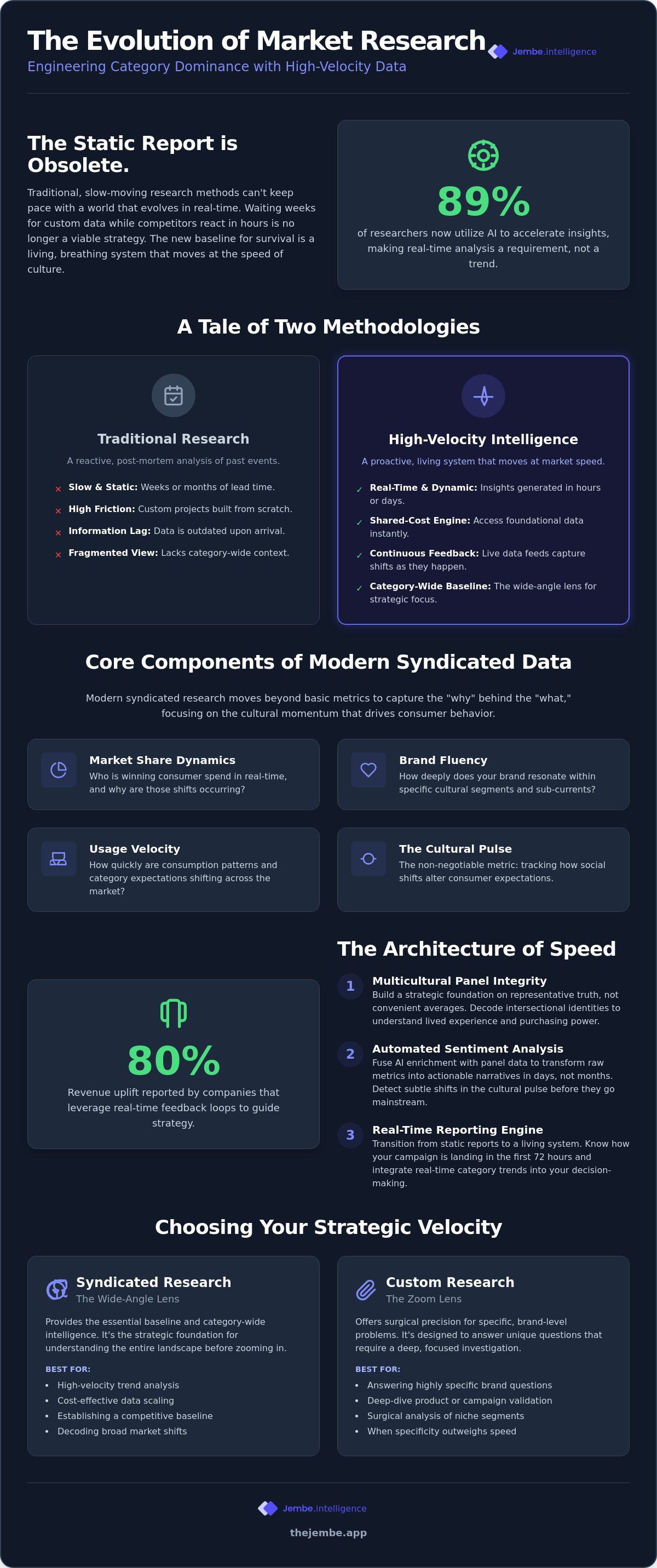
The era of the heavy, static PDF is over. In 2026, quantitative syndicated research has evolved into a high-velocity data stream, functioning as a shared-cost engine for category-wide intelligence. It's a rigorous, systematic study conducted by research firms that allows multiple brands to access the same foundational data. Think of it as the vital signs of your industry. While custom studies offer surgical precision for specific brand problems, syndicated research provides the essential baseline. It's the wide-angle lens you need before you zoom in.
Most research models suffer from a fatal flaw: information lag. By the time a report is published, the consumer has already moved on. Modern quantitative syndicated research now utilizes live data feeds and automated sentiment analysis to capture shifts as they happen. With 89 percent of researchers now utilizing AI regularly, the move to real-time analysis is no longer a trend; it's a requirement. This shift is critical for any brand seeking true cultural intelligence. You cannot build a visionary strategy on fragmented or outdated information. For a deeper dive into methodology, Quantitative marketing research provides the foundational framework for these large-scale efforts.
The Core Components of Modern Syndicated Data
Historically, syndicated reports tracked the "what": market share, brand awareness, and usage frequency. These remain fundamental. However, the 2026 landscape demands more. We've introduced the "cultural pulse" as a non-negotiable metric. This involves tracking how social shifts and technological adoption alter consumer expectations in real-time. It's the difference between knowing someone bought your product and understanding the cultural momentum that drove the purchase.
- Market Share Dynamics: Who is winning the wallet in real-time?
- Brand Fluency: How deeply does your brand resonate within specific cultural segments?
- Usage Velocity: How quickly are consumption patterns shifting across the category?
Syndicated data is the shared intelligence infrastructure of a category.
The Architecture of High-Velocity Syndicated Intelligence
The architecture of modern intelligence isn't a static blueprint. It's a high-velocity engine. Traditional research relies on snapshots; we build cinematic sequences. By fusing large-scale panel surveys with sophisticated machine learning, quantitative syndicated research creates a continuous feedback loop that mirrors the volatility of the real world. This isn't about an annual report gathering dust on a shelf. It's about a living system that updates with the rhythm of the market. For those unfamiliar with the traditional foundation, this Syndicated Research Definition offers a starting point, but the 2026 reality has moved far beyond simple shared costs. It's now about strategic synchronization.
Panel Integrity and Multicultural Nuance
Demographics are the surface. Lived experience is the depth. In a hyper-fragmented market, relying on age and zip code is a strategic dead end. Modern panels must be architected with multicultural nuance at their core, ensuring that every data point reflects the intersectional reality of today's consumer. We don't just count people; we decode identities. This ensures that your strategic foundation is built on representative truth, not just convenient averages. You need to understand how cultural sub-currents influence purchasing power before they hit the mainstream.
Automation and Real-Time Reporting
Speed is the ultimate competitive advantage. By integrating automated sentiment analysis, we transform raw quantitative metrics into actionable narratives in days. This layer of AI enrichment allows us to detect subtle shifts in the cultural pulse that traditional surveys miss. It’s an evolution from data collection to strategic momentum. Companies reporting revenue uplifts of 80 percent from real-time feedback loops understand this shift. They aren't waiting for months to see if a campaign landed; they know in the first 72 hours. To stay ahead of these shifts, many leaders are turning to The Jembe Platform to synchronize their insights with the speed of culture.
Syndicated vs. Custom Research: Choosing Your Strategic Velocity
Velocity is the new currency of strategy. You don't always need to build a custom research engine from scratch. Sometimes, you just need to tap into a high-performance intelligence grid. Custom research projects in 2026 typically command budgets between $25,000 and $65,000 per study. While these offer deep-dive precision, they often move too slowly for a market that shifts in real-time. In contrast, quantitative syndicated research provides immediate access to category-wide trends. This isn't a choice between quality and cost; it's a choice of strategic velocity. When you need to understand the baseline of a new market or benchmark competitors, the syndicated model is your primary accelerator.
The smartest brands embrace a hybrid advantage. They use syndicated data to identify the "where" and custom research to decode the "why." This creates a streamlined workflow that eliminates wasted effort. Why spend weeks discovering a category shift that the shared infrastructure has already identified? By leveraging existing intelligence, you can focus your custom resources on the high-impact problems that are unique to your brand.
When to Lead with Syndicated Data
Use syndicated intelligence to map the terrain before you deploy specialized resources. It provides the essential macro-context required for more granular work like custom cultural persona development. By identifying broad shifts in brand awareness or usage frequency across the category, you can pinpoint exactly where a deep-dive study will yield the highest ROI. This ensures you aren't paying custom prices for discovery that the shared infrastructure already covers. It's about being efficient with your capital and aggressive with your timing.
The Limitations of the Static Model
Don't confuse raw data access with a strategic edge. Many "old-world" firms still deliver information in rigid, disconnected formats that lack the technological sophistication required for 2026. The value isn't in the numbers themselves; it's in the synthesis. If your data isn't being enriched by AI-driven analysis and reporting, you're just staring at a spreadsheet while your rivals are acting on insights. Move beyond the generic. Demand a system that turns category metrics into strategic momentum.
Ready to accelerate? Integrate high-velocity intelligence into your strategy with The Jembe Platform.
From Data to Momentum: Activating Syndicated Insights
Data remains a static asset until it's activated by a visionary strategy. To achieve category dominance, you must treat quantitative syndicated research as a high-frequency signal within your brand’s strategic operating system. It’s the difference between reacting to a market shift and engineering one. By integrating these insights into your daily decision-making, you move beyond the limitations of legacy research. You gain the ability to anticipate consumer evolution before it becomes a headline. This is about precision. It's about movement. It's about ensuring your brand is never caught off guard by a culture that changes in the blink of an eye.
Building a Continuous Intelligence Loop
Stop viewing research as a series of disconnected, annual events. The most agile organizations utilize a continuous loop: monitor syndicated trends, trigger qualitative deep-dives when anomalies appear, and refine strategy in real-time. The Jembe Platform Subscription is designed specifically to enable this evolution. It provides the technological infrastructure to keep your brand in a state of constant adaptation. This isn't just about efficiency; it's about staying alert in a world that never sleeps. You need a system that translates raw numbers into strategic momentum without the typical three-month lag associated with traditional research firms.
Engineering Category Dominance
True dominance is built on fluency. When your brand speaks the language of the consumer with radical relevance, you eliminate the friction of traditional marketing. We position The Jembe as the essential bridge between quantitative rigor and cultural intelligence. It’s time to move past the slow, mechanical tools of the past and embrace a system that feels alive. If you're ready to evolve your insights and outpace the competition, the path forward is clear. In 2026, the fastest brand to understand the consumer wins.
Master Your Strategic Velocity
The landscape of 2026 demands a departure from the slow, fragmented research models of the past. You've seen how quantitative syndicated research provides the high-velocity baseline necessary to navigate a shifting cultural landscape. It isn't just about accessing data; it's about integrating a living intelligence system into your brand's DNA. By leveraging the shared infrastructure of category-wide trends and enriching them with real-time analysis, you position your brand to act while others are still analyzing. Efficiency is no longer just about cost; it's about the speed of your strategic evolution.
We provide visionary cultural intelligence for modern leaders through real-time automated sentiment analysis and managed research services designed for high-velocity environments. The time for static reports has ended. You have the tools to decode complex human behaviors and outpace the competition in real-time. Don't let traditional methods hold back your brand's potential for radical relevance. Accelerate your strategic evolution with The Jembe Platform. Embrace the momentum and lead your category into the future with confidence.
Frequently Asked Questions
What is the main difference between syndicated and custom quantitative research?
Syndicated research is a shared-cost model where multiple brands access the same category-wide data baseline. Custom research is a proprietary investment built to answer one brand's unique questions. While custom work offers surgical precision, quantitative syndicated research provides the essential strategic infrastructure and competitive benchmarking required to understand the broader market environment. It's the difference between studying a single tree and mapping the entire forest. This shared infrastructure often utilizes online surveys, which over 90 percent of market research professionals now use as their primary quantitative tool.
How much does quantitative syndicated research typically cost in 2026?
Industry investment for shared data is designed to be a cost-effective alternative to custom projects. While a typical custom quantitative study in 2026 costs between $25,000 and $65,000, syndicated models allow brands to access category-wide intelligence for a fraction of that investment. This shared-cost structure enables you to scale your data access across multiple markets without the financial friction of building every survey from scratch. It's the most efficient way to maintain a constant pulse on your competition while keeping your overhead lean.
Can syndicated research help with multicultural marketing strategy?
Absolutely. Modern syndicated data is no longer limited to basic demographics; it now integrates cultural pulse metrics to track shifting consumer identities. By utilizing representative sampling across diverse populations, brands can identify how multicultural sub-currents influence purchasing patterns. This provides the necessary foundation for engineering radical relevance within specific communities. You can't lead a culture you don't track in real-time, and syndicated streams provide the high-velocity signals needed to stay ahead of the curve.
How often is syndicated research data updated?
The standard has shifted from static annual reports to continuous, high-velocity data streams. While some traditional firms still offer quarterly updates, cutting-edge platforms provide live dashboards that refresh with the rhythm of the market. This ensures your strategy is built on current momentum rather than historical snapshots. Over 50 percent of organizations are now increasing their research spending on real-time consumer trends to avoid the risks of information lag and ensure they're acting on the most recent data available.
Is syndicated research suitable for small to mid-sized brands?
Yes, it's often the most strategic entry point for growing brands. Quantitative syndicated research allows mid-sized companies to access the same high-level intelligence as global leaders without the prohibitive cost of custom-built studies. It levels the playing field. By tapping into shared category data, smaller teams can identify market gaps and competitive weaknesses with the same rigor as their larger rivals. You don't need a massive enterprise treasury to outsmart the competition; you just need the right data velocity.
Want this kind of intelligence wired into your team's workflow? Get started with Jembe.Intelligence →