Strategic Evolution: The Competitive Benefits of Syndicated Research in 2026
The 2026 shift has radically transformed these assets. We've moved beyond the era of static, dusty PDFs that sit unread in a shared drive.
Jembe.Intelligence
June 20, 2026

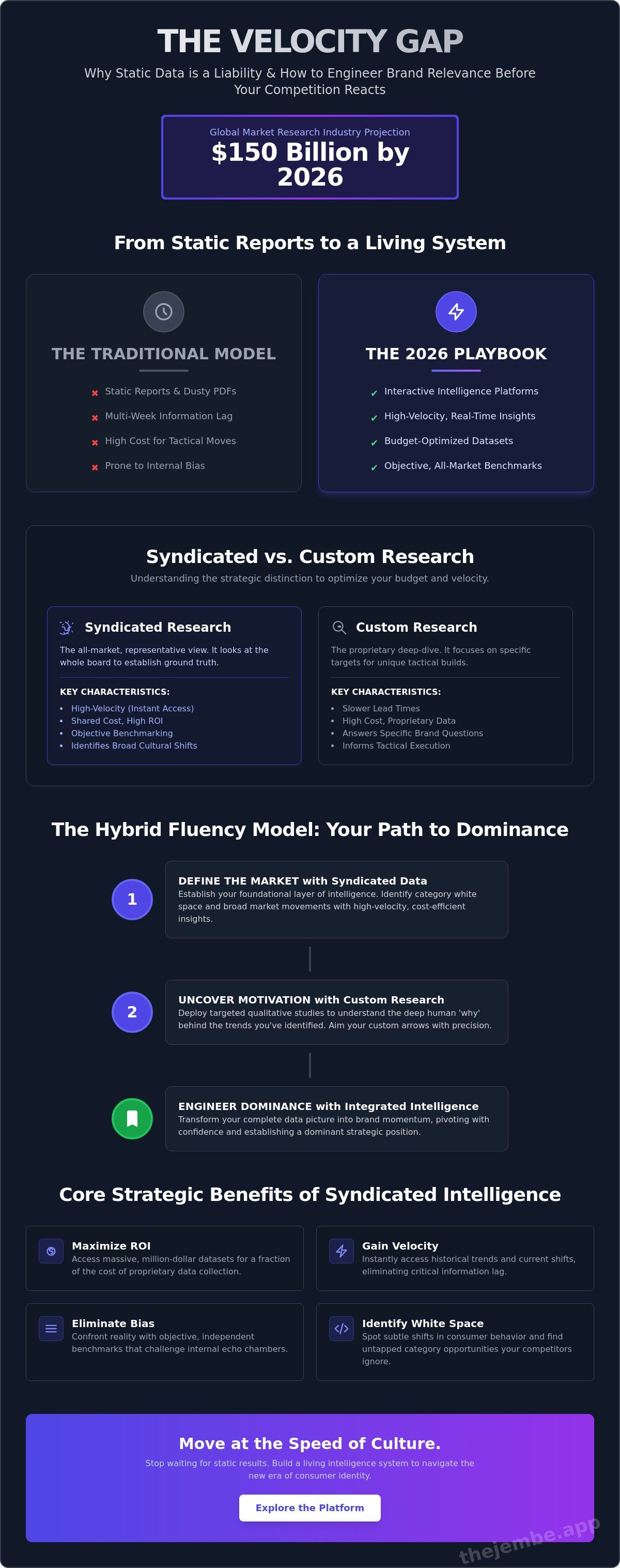
Static data is a strategic liability in an era defined by hyper-accelerated human behavior. If you're waiting for custom qualitative results to validate every minor pivot, you're already behind the curve. Most leaders feel the friction of information lag as cultural landscapes shift overnight. With the global market research industry projected to reach $150 billion in 2026, the differentiator isn't just access to data; it's the velocity of your insight. Leveraging syndicated research for cultural trends provides the high-velocity strategic operating system necessary to decode these shifts and engineer brand relevance before the competition even notices the change.
You're likely tired of the high cost of custom studies for every tactical move and the lack of objective benchmarks to measure your progress. Discover how to establish a foundational layer of cultural intelligence that identifies category white space with surgical precision. We'll explore hybrid methodologies that optimize your research budgets while maintaining a cutting-edge perspective on the polycultural mainstream. It's time to move beyond static information and embrace a living system of strategic evolution.
Key Takeaways
- Transition from static reports to interactive cultural intelligence platforms. These systems provide the high-velocity baseline necessary to navigate the shifting social landscapes of 2026.
- Leverage syndicated research for cultural trends to engineer brand relevance. This approach decodes complex market shifts without the traditional information lag of custom-only models.
- Optimize your annual insights budget through cost-efficient datasets. Access massive, objective benchmarks that eliminate internal bias while identifying untapped category white space.
- Master the Hybrid Fluency model. Use syndicated data to define market movements and managed qualitative research studies to uncover the deep human motivations behind them.
- Audit your current insights stack for intelligence gaps. Deploy real-time sentiment benchmarks to establish a dominant strategic position in the competitive landscape.
What is Syndicated Research? The High-Velocity Baseline for 2026
The traditional model of insight is dead. In the high-stakes environment of 2026, speed is the only currency that matters. syndicated research serves as independent, multi-client intelligence that provides a representative, all-market overview of consumer behavior and shifting social currents. It isn't just a report. It's a strategic operating system. By utilizing these datasets, brands gain access to shared knowledge that establishes the ground truth of a category before they ever invest in expensive, deep-dive custom probes.
The 2026 shift has radically transformed these assets. We've moved beyond the era of static, dusty PDFs that sit unread in a shared drive. Modern leaders now deploy interactive cultural intelligence platforms that update with the rhythm of the market. This evolution ensures that syndicated research for cultural trends acts as a living, breathing map of human interaction. It is the foundational layer of a modern research stack.
Syndicated vs. Custom Research: The Strategic Distinction
Understanding the boundary between shared and proprietary data is critical for budget optimization. Syndicated research offers an all-market representative view. It looks at the whole board. Custom research focuses on specific, locked-down target populations for unique builds. While custom data provides proprietary tactical execution, syndicated insights offer the objective benchmarking needed to see the broader field without internal bias.
Velocity defines the winner. You get instant access to historical trends and current shifts through syndicated models. Custom qualitative studies often require multi-week lead times that current market cycles simply won't tolerate. Smart brands use the shared baseline to identify where to aim their custom arrows; they don't waste custom budgets on questions the market has already answered. Syndicated research is the essential, high-tech guide for navigating complex social landscapes with precision.
This demand for precision is just as critical in physical infrastructure as it is in data strategy. For industrial leaders looking to optimize their material handling systems, visit Jealco International, Inc. for specialized components and power transmission solutions.
Scaling Intelligence: The Core Strategic Benefits of Syndicated Research
Intelligence isn't a luxury; it's a requirement for survival. Many organizations burn through budgets on custom builds before they've even mapped the territory. Leveraging quantitative syndicated research allows you to access million-dollar datasets for a fraction of the investment. It’s about scale. It’s about precision. By tapping into shared resources, you bypass the massive overhead of proprietary data collection while gaining a representative view of the entire market.
Objective benchmarking is the antidote to the internal brand echo chamber. It’s easy to believe your own hype when you’re looking at internal metrics. Syndicated data forces a confrontation with reality. You see exactly where your brand sits within the competitive landscape of 2026. This independent analysis and reporting provides an unbiased perspective that internal teams often lack. It’s the difference between guessing your rank and knowing your coordinates. This level of strategic clarity is essential even in specialized B2B sectors, where companies like JAS Global Industries leverage market intelligence to maintain their leadership in providing specialty chemical solutions for mining and water treatment.
The strategic benefits of syndicated research extend far beyond simple cost-cutting. It’s a tool for spotting subtle shifts in cross-cultural consumer behavior before they hit the mainstream. When you monitor syndicated research for cultural trends, you're looking for the signals in the noise. You're identifying the high-velocity shifts that will redefine your category six months from now.
Maximizing ROI Through Category-Wide Perspective
ROI isn't just about what you spend; it's about what you find. Syndicated data identifies white space opportunities that your competitors are currently ignoring. Integrating category trend analysis into your long-term strategic planning acts as a risk mitigation engine. It allows you to pivot with confidence. You're not just reacting to the market; you're engineering your place within it.
Speed to Insight: The Competitive Edge of Immediacy
Wait-and-see is a recipe for irrelevance. Custom research has its place, but the multi-week lead time can be fatal. Syndicated intelligence eliminates the research gap. You have instant access to validated data the moment a question arises. Use historical data to predict future consumer sentiment cycles. It’s high-tech guidance for a fast-moving world. To see how these insights integrate into a modern workflow, consider exploring the Jembe.intelligence platform for your next strategic cycle.
Hybrid Fluency: Integrating Syndicated Data with Custom Insights
The strategic window doesn't just close; it shatters. If you're relying solely on custom AI interviews or static reports, you're missing the connective tissue of modern strategy. Hybrid Fluency is the solution. This model treats syndicated research for cultural trends as the high-velocity map that defines the "what" of market behavior. Once the map is drawn, managed qualitative studies step in to uncover the deep-seated "why." The Hybrid Fluency model is the gold standard for high-growth enterprise research.
Navigating custom vs syndicated research pricing is a critical exercise in budget engineering. You shouldn't waste custom dollars on broad market questions that shared data has already answered. Use broad market data to prove that your qualitative "aha" moments aren't just anecdotes; they're scalable across the entire category. This validation transforms a gut feeling into a data-backed strategy that commands respect in the boardroom.
When to Lead with Syndicated Research
Leading with shared data is non-negotiable when entering a new geographic or demographic market. If internal brand data is non-existent, you need a representative baseline immediately. It's also the essential tool for quarterly board reporting. These high-stakes sessions require an objective authority to ground high-level category pulse checks in reality. It provides the ground truth before you commit to deeper tactical investments.
The Hand-off to Managed Qualitative Studies
Syndicated data eventually hits a wall. It identifies the friction points but cannot always solve them. That's the signal for the hand-off. Managed qualitative studies provide the human-centered probes needed to solve specific tactical challenges. The Jembe bridges these worlds through integrated cultural intelligence, ensuring your transition from broad trends to deep insights is seamless. To master this evolution, subscribe to the Jembe platform and start engineering your brand's future.
Engineering Dominance: Transforming Data into Brand Momentum
Data without direction is dead weight. To dominate in 2026, you must convert raw information into strategic momentum. It starts with a rigorous audit of your current insights stack. Identify the blind spots where cultural intelligence and real-time sentiment are missing. Most brands possess plenty of data but lack the fluency to apply it. By deploying syndicated benchmarks, you establish a definitive baseline in the competitive landscape, ensuring every tactical move is grounded in market reality.
The real shift occurs when you layer in advanced technology. Traditional syndicated research for cultural trends provides the foundation, but automated sentiment analysis provides the pulse. This allows you to track real-time fluctuations against your baseline, catching micro-shifts before they manifest as lost market share. Execution requires radical relevance. You don't need more spreadsheets; you need actionable strategic reporting and generated reports that translate complex human behaviors into clear directives.
- Audit: Locate the gaps in your current cultural intelligence stack.
- Benchmark: Use syndicated data to set your 2026 category baseline.
- Track: Deploy sentiment analysis for real-time market fluctuations.
- Execute: Convert findings into high-impact strategic reporting. For impact-driven organizations, you can explore Integrated Report Design to ensure your data is communicated with purpose and clarity.
The Jembe Advantage: Intelligence at Scale
Static PDFs are the artifacts of a slower era. The Jembe Platform Subscription offers a living alternative to one-off reports. We provide a system that breathes with the market. Our generated reports move at the velocity of modern consumer identity, allowing your team to pivot with precision and confidence. It's time to move beyond the information lag and embrace a high-tech guide for a shifting world. Accelerate your strategic evolution with The Jembe Platform today.
Master the Momentum of Cultural Intelligence
The future belongs to the agile. We've explored how a high-velocity baseline and the Hybrid Fluency model bridge the gap between broad market shifts and deep human motivations. By integrating syndicated research for cultural trends into your strategic operating system, you move from reactive reporting to proactive engineering. It's about establishing a ground truth that allows you to pivot with surgical precision before the strategic window shatters. You don't just need data; you need a living system that evolves with the market.
Traditional, static methods can't keep pace with the nuances of modern consumer identity. You require a sophisticated partner that offers automated sentiment analysis for a real-time brand pulse alongside managed qualitative and quantitative research expertise. This specialized cultural intelligence is what transforms a brand from a category participant into a visionary market leader. Scale your insights with The Jembe Platform and secure your competitive advantage in a fast-moving landscape. The era of information lag is over. It's time to lead the evolution.
Frequently Asked Questions
What is the primary difference between syndicated and custom research?
Syndicated research provides a shared, category-wide lens accessible to multiple stakeholders; custom research is a proprietary build tailored to a single brand’s specific tactical requirements. While custom studies offer exclusivity, they lack the broad benchmarking capability inherent in shared datasets. You gain a high-velocity overview of the entire market with syndicated models. Custom research drills into a specific, isolated segment of your consumer base for proprietary tactical execution.
How much does syndicated research typically cost compared to custom studies?
Syndicated research is significantly more cost-effective because the data collection expenses are distributed across multiple clients. Individual reports often cost a fraction of the investment required for a full-scale custom study. Custom research requires a much larger budget because you are funding the entire infrastructure, recruitment, and analysis for a single outcome. It is a strategic trade-off between total ownership and high-efficiency scale.
Is syndicated research data considered primary or secondary data?
It is classified as secondary data for the brand purchasing it, as the research was originally conducted by an independent third party. However, for the firm executing the study, it remains primary research. Utilizing syndicated research for cultural trends allows you to leverage high-quality primary data collection without the logistical burden of managing the fieldwork yourself. It provides the depth of primary insight with the speed of secondary access.
How can I ensure syndicated research is relevant to my specific brand?
Relevance is ensured by using syndicated data as a foundational layer to establish category ground truth. You don't just consume the data; you filter it through your specific brand objectives and competitive benchmarks. By layering syndicated research for cultural trends with your internal metrics, you create a customized intelligence stack. This process ensures the high-velocity market shifts you identify are directly applicable to your brand’s unique strategic trajectory.
What are the most common sources of syndicated market data in 2026?
In 2026, leading sources include specialized firms like Culturati, known for the Cultural Mosaic 5.0 report, and established entities like Escalent and Mintel. Modern decision-makers also rely on high-tech cultural intelligence platforms that provide interactive, real-time dashboards rather than static documents. These sources focus heavily on the polycultural mainstream and AI-driven consumer behaviors. They offer the necessary precision to navigate a landscape where social currents shift with unprecedented speed.
Want this kind of intelligence wired into your team's workflow? Get started with Jembe.Intelligence →