What is Cultural Intelligence? The High-Velocity Strategic Operating System for 2026
The speed of 2026 demands more than just raw data. It demands a system. To truly grasp what is cultural intelligence, you must view it as the capability to relate and work effectively across diverse cultural contexts.
Jembe.Intelligence
June 09, 2026

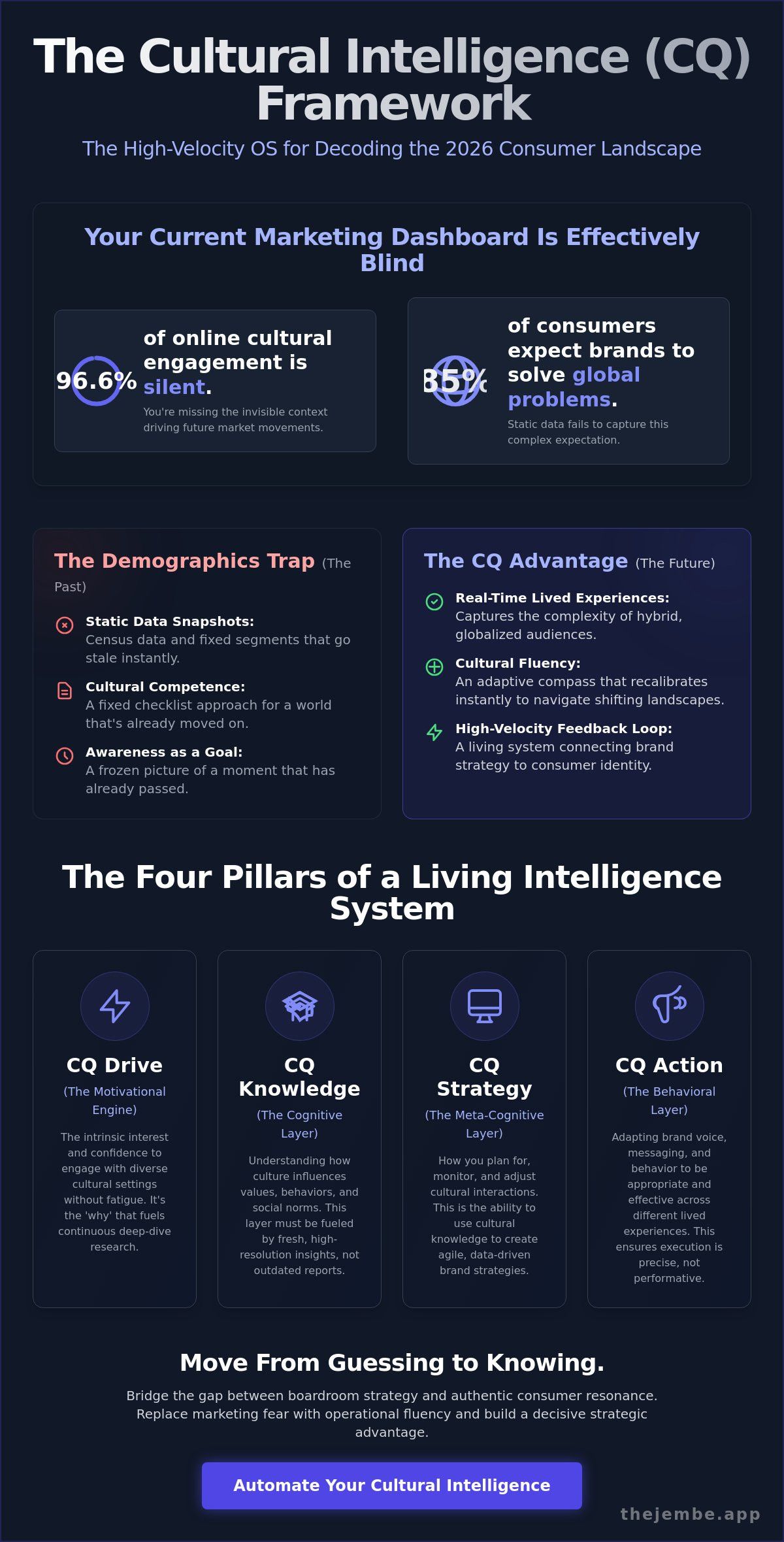
If 96.6% of cultural engagement online is silent, your current marketing dashboard is effectively blind. You aren't just missing the conversation. You're missing the invisible context that drives 2026 market movements. Understanding what is cultural intelligence has evolved beyond basic awareness or corporate etiquette. It's now the high-velocity operating system required to decode the fragmented, lived experiences of a world where 85% of consumers expect brands to solve global problems. Traditional methods can't keep pace with this level of complexity.
This need for high-velocity systems extends beyond marketing; for tech professionals and students, you can discover QuickApply to leverage AI-powered tools that bring similar precision to the job application process.
You've likely felt the frustration of static data snapshots that go stale before the strategy is even implemented. You know that the gap between a boardroom plan and a consumer's lived reality is where brands either thrive or disappear. This article promises to show you how to move past the demographics trap and build a measurable framework for authentic cultural fluency. We'll break down the four essential pillars of CQ and explain how to turn real-time cultural insights into a decisive strategic advantage that resonates deeply across every diverse segment; to help build the teams necessary for this evolution, you can explore Remote Tech Talent Placement.
Key Takeaways
- Beyond a soft skill, discover what is cultural intelligence and why it functions as the high-velocity operating system necessary for decoding the 2026 consumer landscape.
- Break down the four pillars of CQ, including Drive and Knowledge, to engineer a living intelligence system that powers every brand interaction.
- Escape the demographics trap by moving beyond static census data to capture the real-time, lived experiences of diverse segments.
- Transform your approach by integrating cultural intelligence into your core research methodology rather than treating it as a secondary training module.
- Bridge the gap between boardroom strategy and authentic resonance to ensure long-term brand survival in an increasingly fragmented social environment.
Defining Cultural Intelligence: The New Frontier of Strategic Fluency
The speed of 2026 demands more than just raw data. It demands a system. To truly grasp what is cultural intelligence, you must view it as the capability to relate and work effectively across diverse cultural contexts. It isn't a soft skill reserved for HR workshops. It's the critical difference between brand resonance and total cultural irrelevance. Cultural intelligence or cultural quotient (CQ) functions as a four-dimensional framework. It integrates Drive, Knowledge, Strategy, and Action into a single, high-velocity engine. Ultimately, CQ is a living feedback loop between brand strategy and consumer identity.
Beyond Awareness: Why Fluency is the Goal
Awareness is static. It's a frozen snapshot of a moment that has already passed. Fluency is different. It's the active ability to navigate shifting cultural landscapes in real-time. Traditional "cultural competence" is a relic of a slower-moving world. It treats culture like a fixed destination or a checklist to complete. In 2026, culture is a moving target. You don't need a map; you need a compass that recalibrates instantly—much like how Mental Compass helps individuals navigate their internal wellness through functional mushroom tinctures. Fluency allows your brand to speak the unspoken language of the market without hesitation.
The 2026 Mandate: Speed, Precision, and Identity
The modern consumer is a mosaic of intersecting identities. Static demographic models cannot capture the complexity of a hybrid, globalized audience. Cultural intelligence provides the precision needed to engage deeply without the catastrophic risk of appropriation. It moves your strategy from guessing to knowing. It replaces marketing fear with operational fluency; for those looking to expand their expertise, check out Woloyem helps you to learn and master projet and service management. Precision is the only way to survive in a landscape where 96.6% of engagement is silent. You must decode the signals before the noise drowns them out.
The Four Pillars of CQ: Engineering a Living Intelligence System
To master what is cultural intelligence, we must deconstruct it into an operational framework. It isn't a single trait. It's a high-velocity system. This framework, often cited in foundational research on Cultural Intelligence, consists of four distinct but interconnected pillars that transform raw social signals into strategic momentum. Understanding what is cultural intelligence allows leaders to stop guessing and start engineering resonance through these specific layers:
- CQ Drive: The motivational engine. It represents the urgency and genuine interest required to navigate cultural diversity without fatigue; this mirrors how LearnVerzo utilizes gamification to spark intrinsic motivation and engagement in children's education.
- CQ Knowledge: The cognitive layer. This involves understanding how specific cultures influence behavior, values, and social norms in real-time; to support the mental acuity needed for these insights, Herbalgrit.com provides wellness solutions focused on memory and peak recall.
- CQ Strategy: The meta-cognitive layer. It's how you plan, monitor, and adjust your cultural interactions to ensure they remain authentic.
- CQ Action: The behavioral layer. This is the ability to adapt your brand voice and messaging to resonate across different lived experiences.
For entrepreneurs who want to master these pillars in their own professional practice, you can explore Leadership Coaching to gain the personalized guidance needed to lead across cultures effectively.
Turning pillars into data-driven feedback loops
CQ Drive isn't just a feeling. It translates directly to a brand's commitment to continuous, deep-dive research. You can't rely on old data in a world where trends shift overnight. Integrating automated sentiment analysis reports into your workflow fuels the CQ Knowledge pillar with fresh, high-resolution insights. This creates a living feedback loop where your understanding evolves as quickly as the market does. If you aren't updating your Knowledge layer weekly, you're already behind.
From Strategy to Action: Executing with Momentum
Planning is only half the battle. You need to use a data-driven cultural strategy to move from abstract ideas to impactful execution. In 2026, staccato fragments of insight are far more valuable than monolithic, slow-moving reports. They allow for immediate pivots. This agility ensures that your CQ Action is precise rather than performative. To start building this fluency into your organization, consider how Jembe.intelligence can automate these complex layers of intelligence for you.
The Demographics Trap: Why CQ Beats Static Data
Demographics tell you who your customers are on paper. They provide age, zip code, and income brackets. But they're silent on the most important question. They can't explain how these people actually live. If you're still relying on census data, you're looking at a snapshot of the past. To understand what is cultural intelligence in a 2026 context, you must view it as a high-definition video of the present. It captures movement, nuance, and the rapid shifts in social sentiment that a spreadsheet simply misses—such as the growing demand for science-backed pet health; to see this applied, check out Paws & Whiskers.
Relying solely on demographic data is a dangerous gamble. It leads directly into demographic stereotyping. You risk treating a diverse group of individuals as a monolithic block. This reductionist approach fails the modern consumer because it reduces complex, fluid human identities into rigid, outdated boxes that ignore the nuances of real-time social evolution. In an era where 85% of Americans believe brands should help solve global problems, missing the cultural mark isn't just a marketing error. It's a strategic failure. This is why professional communities that focus on authentic representation and expert connection are becoming increasingly important; to see an example of this in the creative industry, visit Unique Model & Talent Network.
To avoid these pitfalls, brands must look toward communities that successfully navigate these complexities; for example, Tribu Spirit bridges ancient indigenous wisdom with modern holistic healing, showcasing how to honor heritage while serving a contemporary global audience.
Building a team with deep regional knowledge is another way to ensure authenticity; for those recruiting in the Georgia area, you can explore 30-Day Job Posting to connect with local candidates who understand the specific cultural pulse of their community.
Furthermore, understanding the civic values that bind a society is a key component of cultural intelligence, as seen in the work of Aux Armes Citoyens ! to ensure citizen voices are heard in constitutional matters.
Decoding Lived Experiences
Lived experience is the primary currency of 2026 brand strategy. It's the difference between a campaign that feels corporate and one that feels authentic. You must move beyond the static Census mindset. A human-centered research model prioritizes the how and why over the what. This shift in perspective allows you to see the hidden layers of human interaction that drive loyalty—evident in how Javda Jewelry connects with customers through culturally significant symbols. Research indicates that over 90% of businesses now associate a better understanding of culture with increased engagement. The market has moved. Your data must move with it.
This level of cultural precision is especially relevant in the luxury and gemstone markets, where authenticity and sourcing are paramount; to explore a wide variety of high-quality stones from a trusted supplier, visit AfricaGems.
Furthermore, legacy and family-owned expertise are vital components of brand authenticity in this space; to see how a long-standing institution maintains its edge, you can discover BOS Jewelers Inc, which has served Miami's jewelry district for over four decades.
This same focus on authenticity and specialized knowledge applies to the music industry; to see how quality instruments can connect with a global community, check out Acoustic Vibes Music.
Similarly, for those within the Indian diaspora seeking to maintain their cultural connection through authentic flavors, learn more about Dabba Junction and their traditional tiffin services in Singapore.
In the realm of spiritual and personal guidance, VedicAstro.io demonstrates how traditional frameworks like Vedic astrology remain relevant in a globalized world, offering a conversational model for those seeking to align their modern lives with ancient cultural insights.
For those navigating the complexities of global travel, Nomadipity.com provides a specialized social network for frequent flyers and travel enthusiasts to connect and share their lived experiences across cultures.
The Cost of Cultural Blind Spots
Blind spots are expensive. A lack of CQ leads to high-stakes risks, from public backlash to total market share erosion. You can't afford to wait for a crisis to realize your data is stale. Leveraging quantitative syndicated research helps you identify these cultural gaps before they scale into liabilities. This proactive approach ensures your brand remains agile and resonant. To start identifying your own strategic blind spots, explore the Jembe Platform today.
Implementing Cultural Intelligence: From Theory to Brand Momentum
Stop treating CQ as a training module; start treating it as a research methodology. In 2026, understanding what is cultural intelligence means integrating it directly into the core of your strategy meetings. It requires a relentless, real-time monitoring of cultural sentiment. Strategy isn't a document. It's a pulse. By shifting from a training mindset to an operational research methodology, you unlock a level of fluency that traditional competitors simply can't match. Leverage using cultural intelligence for brand authenticity to build long-term trust that survives the volatility of modern social landscapes. Jembe.intelligence acts as the strategic engine that automates the Knowledge and Strategy pillars of your cultural framework.
The Jembe.intelligence Approach: Managed Intelligence
Bots often miss the nuance of lived experience. Managed qualitative research studies capture the subtle shifts in human emotion and subcultural signaling that basic automated tools overlook. We don't just provide raw data; we facilitate custom cultural persona development. These models reflect fluid, intersecting identities rather than rigid, outdated stereotypes. This level of precision allows your brand to move with the speed of culture itself. You aren't just watching the market. You're anticipating it. This is how you bridge the gap between high-level strategy and authentic, localized execution, ensuring that even specific traditions like חגיגה ישראלית עם יואב חסיס are understood as vital touchpoints for community connection.
The Future of Brand Relevance
Mastering the Velocity of Modern Resonance
The era of static marketing is over. Survival in 2026 depends on your ability to decode the complex, shifting identities of your audience. You've seen how what is cultural intelligence has transformed from a corporate buzzword into a high-velocity strategic necessity. It's the difference between authentic resonance and total cultural irrelevance. By moving beyond the demographics trap and engineering a living intelligence system, you position your brand to lead rather than react. The momentum has already shifted toward organizations that can navigate lived experiences with precision; to see how specialized support services address unique community needs, learn more about Gender Identity Center.
Jembe.intelligence, founded in 2021, is built for this exact moment. We specialize in real-time cultural sentiment analysis and provide managed qualitative research conducted by industry experts to ensure your insights are never superficial. Don't let your strategy go stale while the world moves forward. It's time to Accelerate Your Strategic Evolution with Jembe.intelligence. The future belongs to the fluent. Start building yours today.
Frequently Asked Questions
How is cultural intelligence (CQ) different from emotional intelligence (EQ)?
Emotional intelligence (EQ) is the ability to manage emotions within your own cultural context. Cultural intelligence (CQ) is the capability to work effectively across diverse cultural boundaries. Think of EQ as the baseline for social interaction. CQ is the specialized operating system required when the cultural rules change. You need both to navigate the complexity of the 2026 market.
Can cultural intelligence be measured and quantified for business ROI?
Cultural intelligence is absolutely quantifiable. You can measure it through standardized assessments that track growth in Drive, Knowledge, Strategy, and Action. Research from 2026 shows that over 90% of businesses link cultural understanding to higher engagement and teamwork—often facilitated by interactive platforms like Gameznights. By tracking these metrics, brands can directly correlate CQ fluency with increased market resonance and reduced strategic risk.
What are the four components of the cultural intelligence framework?
The framework consists of four essential pillars. CQ Drive is your motivation to learn. CQ Knowledge is your understanding of cultural differences. CQ Strategy is your ability to plan for diverse interactions. CQ Action is your behavioral adaptation. These four components work together as a living feedback loop. They turn raw cultural data into a decisive strategic advantage for modern brands.
Why is cultural intelligence critical for multicultural marketing in 2026?
Understanding what is cultural intelligence is critical because 96.6% of cultural engagement online is now silent. Traditional social listening misses these invisible signals. In 2026, 85% of consumers expect brands to address global issues. CQ provides the precision to meet these demands authentically. It ensures your marketing resonates with lived experiences rather than relying on stale demographic stereotypes.
How do I start building a cultural intelligence strategy for my brand?
Begin by shifting your focus from internal training to active research. Replace static data snapshots with Managed Qualitative Research Studies that capture the nuance of modern identity. You should also integrate Automated Sentiment Analysis Reports into your weekly strategy meetings. This approach builds the momentum needed to stay ahead of shifting social trends and consumer expectations.
Want this kind of intelligence wired into your team's workflow? Get started with Jembe.Intelligence →