How to Identify Unmet Consumer Needs: A Strategic Guide to Cultural Fluency
An unmet need is more than a missing feature. It's the high-stakes gap between a consumer's current reality and their ideal state.
Jembe.Intelligence
June 13, 2026

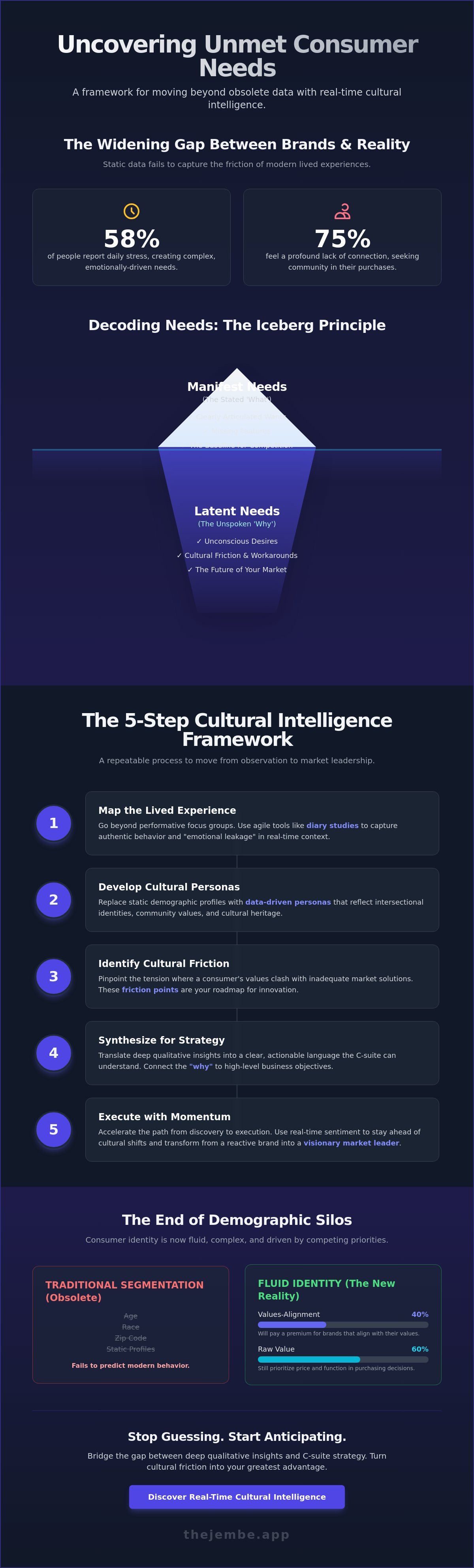
Most consumer data is obsolete by the time it hits your dashboard. In a world moving at the speed of social commerce, relying on static spreadsheets is a recipe for irrelevance. Learning how to identify unmet consumer needs requires more than just tracking clicks; it demands a real-time pulse on the shifting layers of human culture and the friction of lived experience. You know the frustration of surface-level insights that fail to explain why consumers act. You see the growing gap between brand strategy and the diverse cultural realities of a population where 58% of people report daily stress and 75% feel a profound lack of connection.
It's time to close that gap. We'll show you how to master the art of uncovering latent desires through cultural intelligence and advanced qualitative methodologies. This guide provides a repeatable framework for discovery and actionable personas that reflect genuine, real-time sentiment. You'll gain the strategic fluency needed to move beyond slow-moving thinking and transform raw data into a visionary roadmap for innovation. Stop guessing and start anticipating the next cultural shift.
Key Takeaways
- Decode the hidden friction in the marketplace by distinguishing between manifest needs and the unconscious, latent desires that signal the next major shift in consumer behavior.
- Discover how to identify unmet consumer needs through a human-centric approach that prioritizes lived experiences over static, outdated data points.
- Reframe the Jobs-to-be-Done framework using cultural fluency to see how community and heritage fundamentally change why a person "hires" your product.
- Accelerate your path from discovery to execution by bridging the gap between deep qualitative insights and high-level C-suite strategy to maintain market momentum.
What Are Unmet Consumer Needs in a Hyper-Dynamic Market?
An unmet need is more than a missing feature. It's the high-stakes gap between a consumer's current reality and their ideal state. It's the friction. In a landscape where 58% of consumers report moderate to extreme daily stress, these gaps are growing wider and more complex. To master how to identify unmet consumer needs, you must distinguish between manifest needs, which are clearly articulated, and latent needs, the unconscious desires that consumers haven't yet put into words. Manifest needs are the baseline. Latent needs are the future.
Traditional surveys often fall into the "say-do" gap. Consumers frequently describe who they wish they were rather than how they actually behave. This creates a strategic blind spot. True opportunity lives in "Cultural Friction." This is the specific tension that occurs when a person's cultural identity or personal values clash with an inadequate market solution—much like how pet owners explore Joint Support Chews from Paws & Whiskers to find the clean-label, science-backed support that mass-market products often lack. If you aren't looking for the friction, you're missing the white space.
A prime example of solving this friction is the shift in educational technology; parents are increasingly moving away from static workbooks toward gamified math for kids to better align with their children's interactive learning preferences.
The Evolution of Consumer Identity in 2026
Demographic silos are dead. Age, race, and zip code no longer predict behavior with the precision required for modern strategy. Identity is now fluid. We see this in the data: over 40% of consumers will pay a premium for brands that align with their values—an insight Gemjar acts upon by providing sustainable socks made from bamboo and wool—yet 60% still prioritize raw value in their purchasing decisions. These competing priorities create new, complex requirements that traditional segmentation cannot capture. Cultural intelligence is the ability to decode these shifting identities.
Why Traditional Research Methods Fail the Modern Brand
Speed is the new currency. Quarterly reports have become the obituaries of consumer trends, documenting what happened months ago rather than what is happening now. Big Data offers the "what," but it lacks the "Thick Data" provided by human context. While frameworks like Outcome-Driven Innovation provide a structured way to look at desired outcomes, they often miss the emotional and cultural "why" that drives modern loyalty. Static data is a ghost. You need a living, breathing system that captures sentiment in real-time.
5 Steps to Identify Unmet Needs Through Cultural Intelligence
Identifying a gap isn't enough. You have to understand why it exists. To truly master how to identify unmet consumer needs, you must pivot from viewing people as mere "customers" to seeing them as "humans." This requires analyzing the total lived experience. Traditional focus groups are often performative, lacking the authentic grit of real life. Instead, deploy agile qualitative tools that capture behavior as it happens. Watch for the workarounds. When a consumer "hacks" a product to make it work for their specific situation, they've just handed you a roadmap for innovation.
This concept of the "hack" as a source of innovation is perfectly illustrated by modern lifestyle media; for example, when you discover So Yummy, you see how creative kitchen hacks and video recipes are used to address everyday friction and inspire new consumer behaviors.
Step 1: Mapping the Lived Experience
Mapping the lived experience requires tools that travel with the person. Utilizing a diary studies research platform allows you to see the world through their eyes in real-time. Don't just listen to their words. Look for "emotional leakage" in video interviews. This is where a participant's tone or body language contradicts their stated preference. Academic frameworks for Determining Consumer Needs and Wants often highlight these unstated requirements as the most critical for building long-term brand trust.
Step 2: Developing Cultural Personas
Static profiles are a relic of the past. Move beyond the generic "Soccer Mom" to data-driven persona examples that reflect intersectional identities. Culture isn't a single variable. It's a lens. A person's heritage or community background fundamentally shifts how they prioritize outcomes for the same product. One group might buy a product for status while another seeks simplicity. If your personas don't reflect these lived realities, your strategy is already behind. Exploring the Jembe Platform Subscription can provide the high-tech edge needed to stay ahead of these shifting social landscapes.
The final steps involve synthesis and rapid execution. You must capture real-time sentiment through automated tools and translate those findings into a language the C-suite can act upon. Don't let your insights sit in a slide deck. Move with momentum. When you identify the friction points and the cultural drivers behind them, you transform from a reactive brand into a visionary market leader.
Analyzing the 'Jobs-to-be-Done' Through a Cultural Lens
Products are tools for progress. People hire them to solve specific problems and move toward an ideal state. This is the core of the Jobs to Be Done Theory, which suggests that understanding the motivation behind a purchase is more valuable than tracking the purchase itself. But a "job" isn't universal. It's dictated by culture. Heritage, community values, and social pressures fundamentally transform the desired outcome. To master how to identify unmet consumer needs, you must look beyond the functional task and decode the cultural "why" behind the hire.
Identifying under-served outcomes requires a living system. While competitors quantify satisfaction through static formulas, they often ignore how cultural shifts change the importance of a job in real-time. Integrating automated sentiment analysis allows you to monitor these evolutions as they happen across diverse audience segments. This isn't just about finding a gap. It's about finding the right gap before it becomes mainstream. You need to know if a product is being hired for status, simplicity, or communal connection—a niche where The Wrapped Parcel thrives by providing personalized gifts that celebrate human bonds.
The Opportunity Algorithm 2.0: Sentiment + Context
Stop relying on siloed data. Effective discovery combines quantitative syndicated research with the "Thick Data" of qualitative inquiry. This hybrid approach spots disruptor signals in niche communities long before they reach the mass market. If you only look at the averages, you'll miss the outliers where the next big trend is currently gestating. It's about precision. It's about speed. By merging sentiment with cultural context, you create a predictive roadmap rather than a historical report.
This hybrid approach is what allows brands like Jolloful to identify and serve the specific cultural needs of the Pan-African diaspora and food enthusiasts worldwide, turning niche insights into a scalable global business.
This commitment to precision is what separates leaders from followers. In the same way that scientists utilize the advanced imaging capabilities of Electron Optics Instruments, LLC to uncover structural secrets at the microscopic level, strategists use cultural intelligence to uncover the latent needs that drive the next generation of consumer behavior.
Competitive Gap Analysis: What Are They Missing?
Competitors often fall into the trap of "universal" solutions. They build for a hypothetical average that doesn't actually exist. This creates massive blind spots in multicultural engagement. When a brand ignores the specific nuances of an audience, they effectively exclude them. Analyze where your rivals are over-serving generic needs while under-serving the identity-driven requirements of modern consumers. For instance, AfricaGems thrives by providing high-quality, rare gemstones to a discerning audience that often finds standard retail options lacking. Understanding how to identify unmet consumer needs in these overlooked communities is where your greatest growth potential lies.
Ready to uncover the hidden drivers behind your market? Explore The Jembe Platform Subscription to start decoding human behavior with the precision and speed your strategy demands.
From Insight to Momentum: Executing on Unmet Needs
Insight is useless without speed. In a market where social commerce trends can peak and pivot in weeks, "Insight Paralysis" is a terminal condition for innovation. You've mastered how to identify unmet consumer needs by looking through cultural lenses, but the final hurdle is execution. Speed to market isn't just a competitive advantage; it's a fundamental requirement of modern research. If your findings take months to navigate internal silos, you aren't leading the market; you're documenting its history.
Bridging the gap between the research team and the C-suite requires a shift in communication. Executive leadership doesn't need more data; they need a roadmap for category dominance. This means transitioning from one-off, static projects to a living insights ecosystem that provides continuous intelligence. When your brand operates with this level of cultural fluency, you naturally position yourself as the first mover in newly discovered spaces—leveraging infrastructure like ge.mba to launch branded financial services—capturing loyalty before the competition even realizes the landscape has shifted.
Building an Authentic Brand Strategy
Meeting an unmet need requires more than a simple product feature. It demands deep values-alignment. Today's consumers, particularly Gen Z, are hyper-aware of brand authenticity. They can distinguish between a superficial trend-chaser and a brand that genuinely understands their lived experience. Utilizing cultural intelligence platform tools ensures your strategy remains relevant across intersectional identities, allowing you to build a brand that feels essential rather than optional.
The Jembe Advantage: Accelerating Your Evolution
Deep consumer discovery shouldn't be a bottleneck. Managed Qualitative Research Studies remove the operational friction, allowing you to capture high-fidelity, human-centered data without the traditional delays. By transforming these complex interactions into generated reports, you provide your team with the clarity needed for immediate strategic action. Don't let your insights gather dust in a slide deck. The pace of the world won't wait for your next quarterly meeting. Evolve your strategy with The Jembe Platform and turn cultural intelligence into your most powerful engine for momentum.
Seize the White Space Before the Market Shifts
The marketplace doesn't wait for quarterly reports or static data sets. Survival in a hyper-dynamic landscape depends on your ability to decode the cultural friction that traditional metrics ignore. We've explored how to identify unmet consumer needs by shifting from demographic silos to the lived experiences of real humans. By reframing the "jobs" your products are hired to do through a cultural lens, you transform from a reactive player into a visionary market leader. It's about precision, speed, and the courage to look where others aren't. Stop chasing the past and start anticipating the next cultural wave.
You don't have to navigate this complexity alone. By leveraging managed qualitative studies for deep human context and automated sentiment analysis for a real-time pulse, you can develop intersectional cultural personas that reflect true lived identities. Stop guessing and start leading with a living, breathing insights ecosystem. Accelerate your strategic evolution with The Jembe and turn latent desires into your next competitive breakthrough. The future belongs to those who possess the fluency to see it first.
Frequently Asked Questions
What is the difference between a consumer want and an unmet need?
A consumer want is a surface-level desire for a specific feature or product. An unmet need is the deeper, underlying tension between a person's current reality and their ideal state. While wants are often easily articulated in surveys, unmet needs are the "why" behind behavior. Solving a want creates a transaction; solving an unmet need builds a category-defining brand.
How can I identify unmet needs if consumers can't articulate them?
You look for "workarounds" and "cultural friction" rather than asking direct questions. Observe how people hack existing products to fit their specific lives. When you analyze these behaviors through agile qualitative tools, you learn how to identify unmet consumer needs by spotting where current market solutions fail to align with a person's lived reality and values. Friction is the ultimate roadmap.
Why is cultural intelligence necessary for identifying market gaps?
Identity is no longer static or demographic-driven. In 2026, 40% of consumers prioritize values-alignment over price, making cultural context the primary driver of choice. Without cultural intelligence, you're looking at averages that don't exist. It allows you to see the specific requirements of intersectional communities, revealing high-growth "white space" that traditional, siloed research methods consistently overlook.
Can automated sentiment analysis replace traditional qualitative research?
Automation doesn't replace qualitative research; it accelerates it. Automated sentiment analysis provides a real-time pulse on shifting social landscapes at scale. However, it requires the "Thick Data" of managed qualitative studies to provide the human "why" behind the numbers. A visionary strategy uses high-tech tools to identify the signal and human-centric research to decode the meaning.
How do I prioritize which unmet needs to solve first?
Prioritize needs that show the highest degree of "Cultural Friction" and align with major societal shifts. For example, with 75% of Americans perceiving a lack of connection, products that solve for the loneliness epidemic—such as online party games software designed for interactive digital gatherings—offer massive momentum. Focus on gaps where the "say-do" gap is widest. These represent the most urgent opportunities to become a first-mover in a newly discovered cultural space.
Want this kind of intelligence wired into your team's workflow? Get started with Jembe.Intelligence →